
Asus ROG Strix Pulsar XG27AQNGV
Introduction
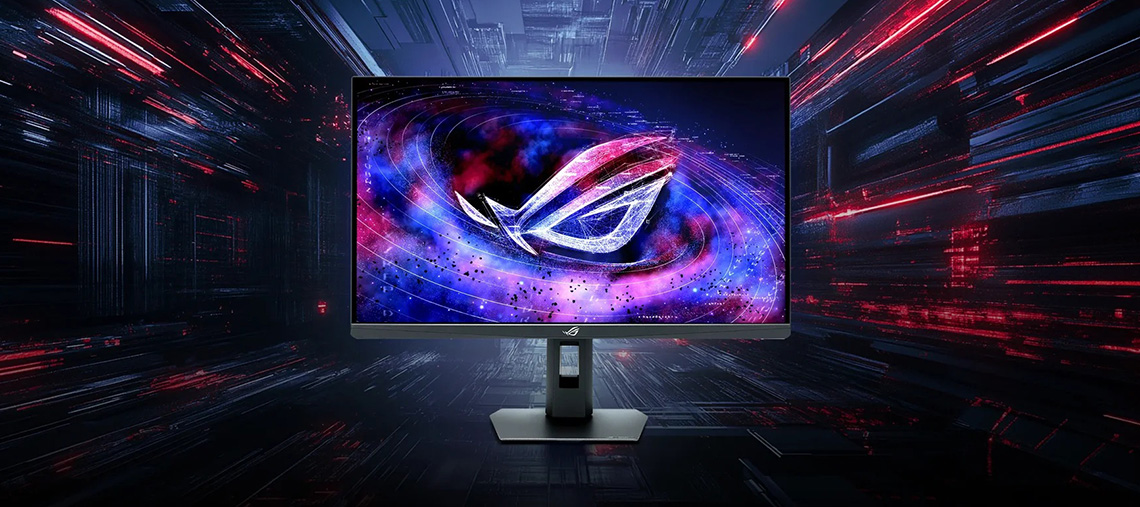
NVIDIA G-sync Pulsar is finally here! This technology was first announced all the way back in January 2024 and we first saw a prototype of the technology in an Asus screen later that year at Gamescom in August 2024. 2 years on, and it’s finally been brought to market and available to buy! G-sync Pulsar is the company’s latest innovation which combines their proprietary strobing blur reduction technology (ULMB 2) with Variable Refresh Rates (VRR) for the first time, offering gamers a killer combination for an impressive gaming experience. We’ll explain a lot more about what Pulsar is, how it works and how it performs throughout this review.
The screen we will be reviewing in full here is the Asus ROG Strix XG27AQNGV, one of 4 newly released monitors from 4 different brands which feature the same underlying panel. It’s a 27″ sized screen with an ‘Ultrafast IPS’ LCD technology panel, a 2560 x 1440 resolution and a 360Hz refresh rate. Using the new MediaTek scaler with G-sync software, the screen also supports proper NVIDIA G-sync VRR and all the benefits that offers, along with a newly added feature called ‘Ambient Adaptive’ technology too.
Pulsar is all about amazing motion clarity and gaming experience so we will provide comparisons against the fastest OLED screens as well, so you can decide which gaming technology is right for you. During the course of this review NVIDIA also released a new firmware for the Pulsar screens so we will test that here as well.
#affiliate. We may earn a commission if you purchase from our affiliate links in this content – TFTCentral is a participant in the Amazon Services LLC Associates Programme, an affiliate advertising programme designed to provide a means for sites to earn advertising fees by advertising and linking to Amazon.com, Amazon.co.uk, Amazon.de, Amazon.ca and other Amazon stores worldwide. We also participate in a similar scheme for Overclockers.co.uk, Newegg, Bestbuy, Walmart, B&H and some manufacturers.
Key Specs
- 27″ screen size, flat format
- ‘Ultrafast IPS’ panel technology (LCD) from AU Optronics (M270DAN10.6)
- 2560 x 1440 resolution
- 360Hz refresh rate
- Extended colour gamut covering 90% DCI-P3
- NVIDIA G-sync Pulsar blur reduction mode
- NVIDIA G-sync VRR (using MediaTek scaler and G-sync capabilities)
- NVIDIA G-sync Ambient Adaptive technology (ambient light sensor)
- 1x DisplayPort 1.4, 2x HDMI 2.1 video connections, 3x USB data ports and 1x headphone jack
- Fully adjustable stand with tilt, height, swivel and rotate

Design and Features
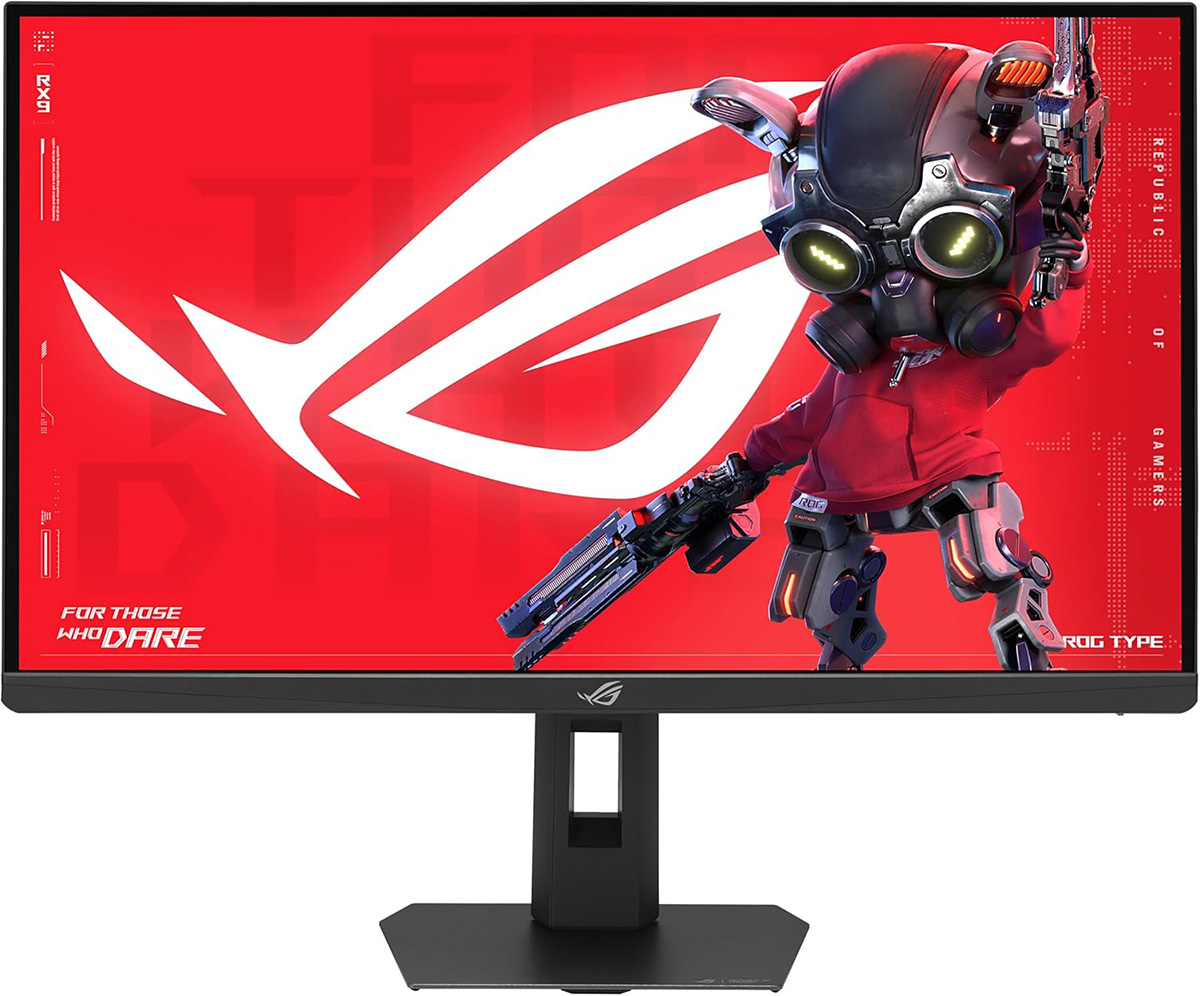
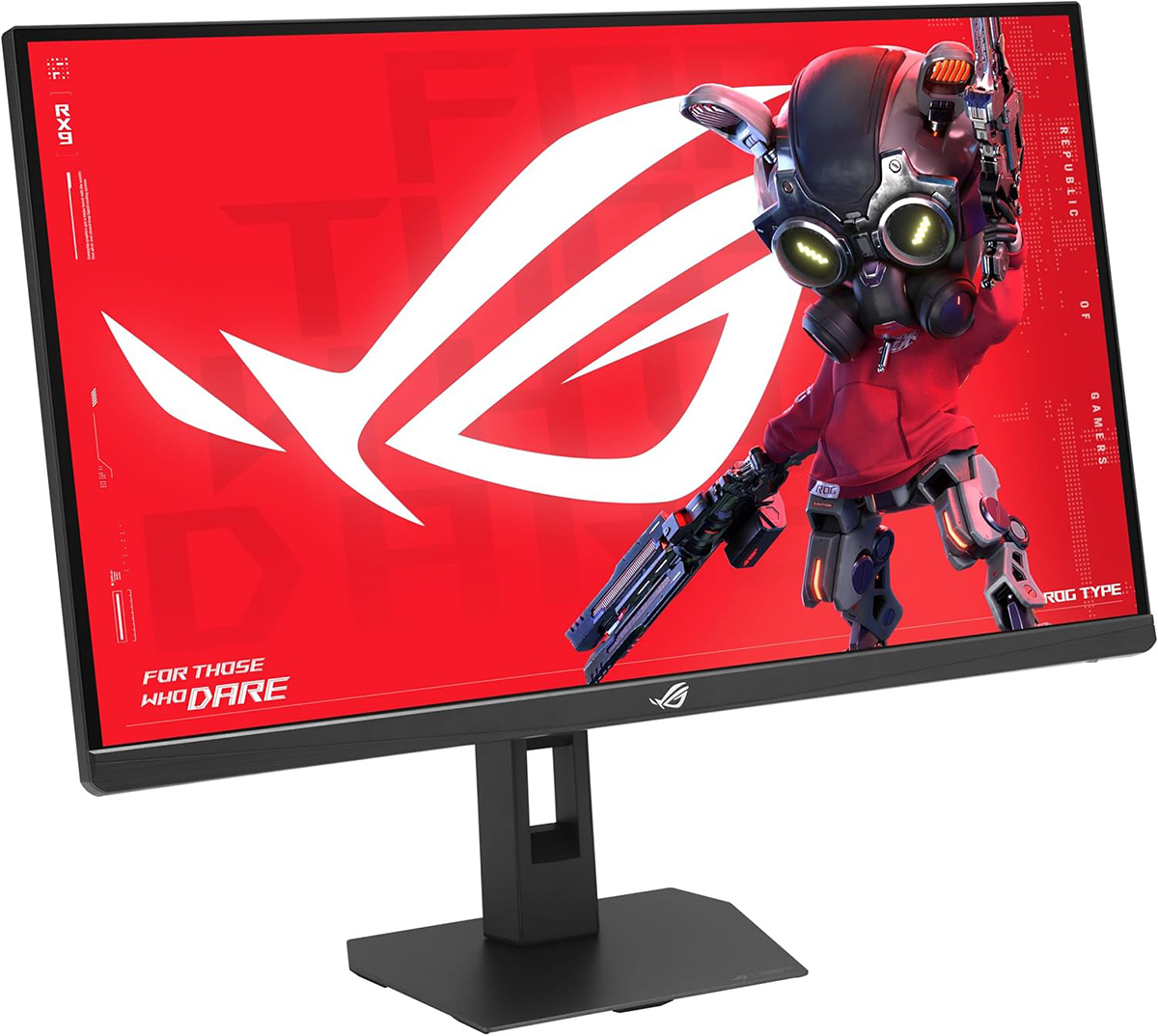
The XG27AQNGV comes in an all-black design with a 3-side “borderless” panel. There’s a thin black panel edge as well so the total border measures ~ 8mm along the top and ~8.5mm along the sides. A standard black plastic bezel is present along the bottom edge which measures 22mm thick and has a shiny silver Asus logo in the middle.
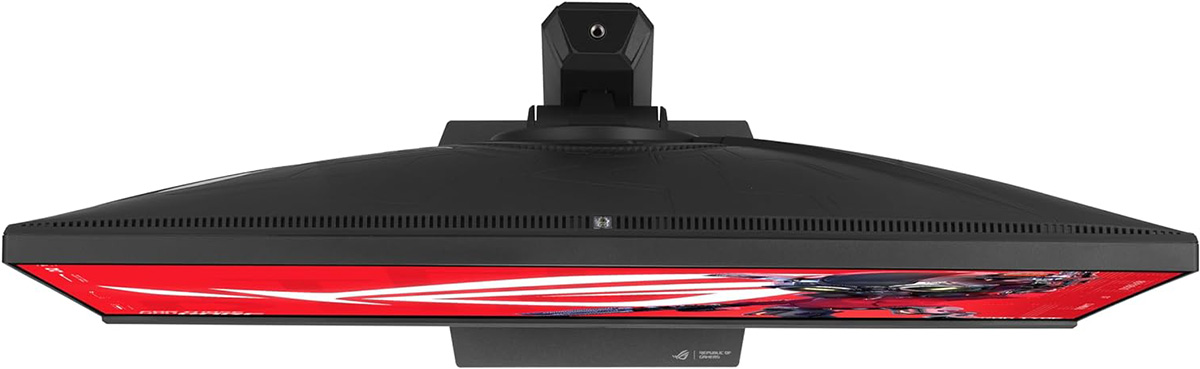
The stand has a black plastic arm and a dark grey metal foot which provides a small footprint on your desk and leaves you with plenty of space for your keyboard and mouse. There’s a tripod socket on the top of the stand for webcam attachment etc if needed.
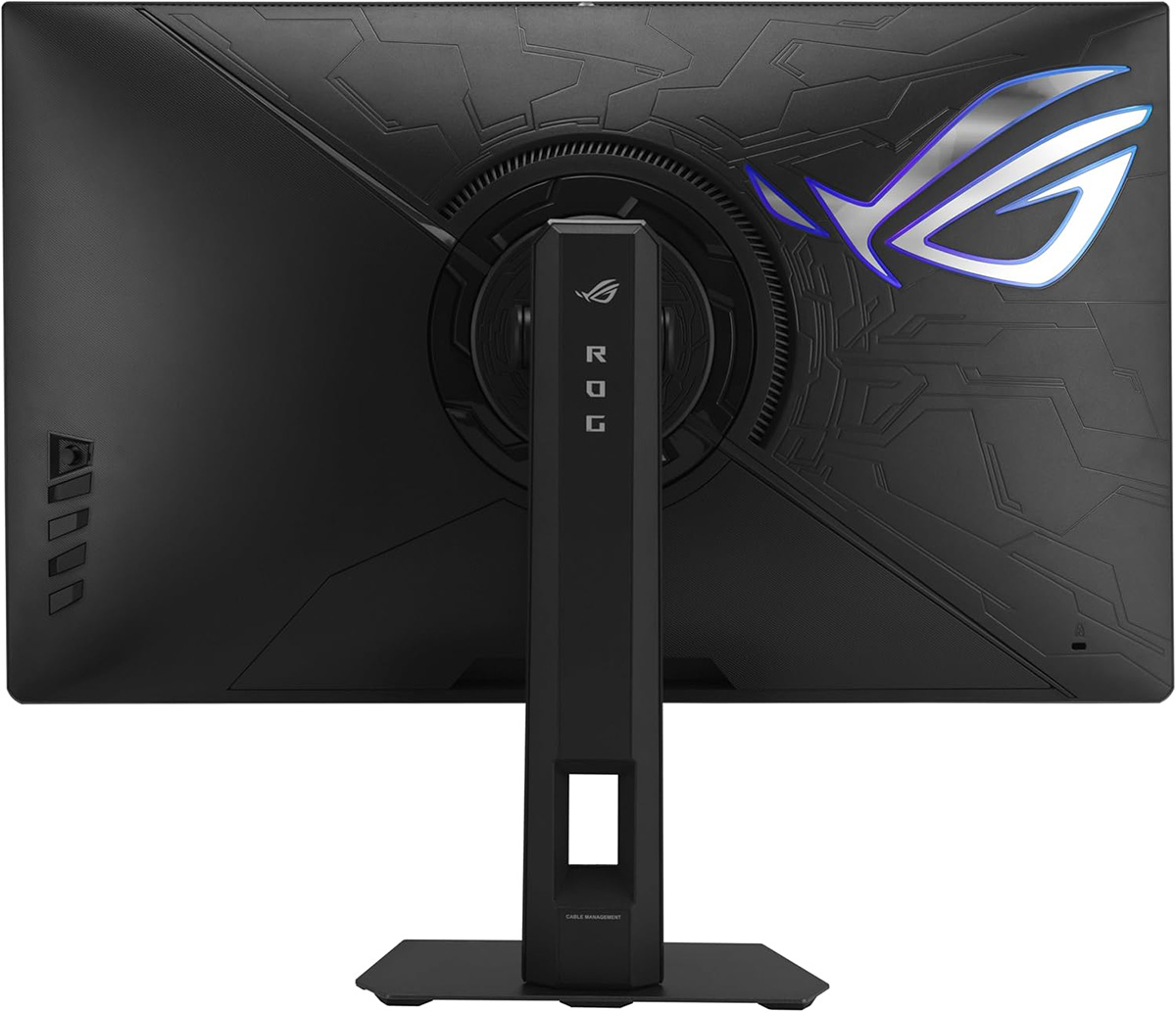
The stand has a quick release mechanism to attach to the back of the screen, or it can be removed for VESA 100 x 100mm mounting if you’d prefer.
The rear is encased in a matte black plastic with some etched patterns in places, and a shiny silver Asus logo at the top right, with an RGB lighting feature around the edges of it. That can be customised or turned off via the OSD menu, or it can also be synced with other Asus ‘Aura Sync’ devices. There’s a cable tidy hole in the back of the arm, and the OSD control buttons and joystick toggle are located on the left hand side as shown above.
Connectivity
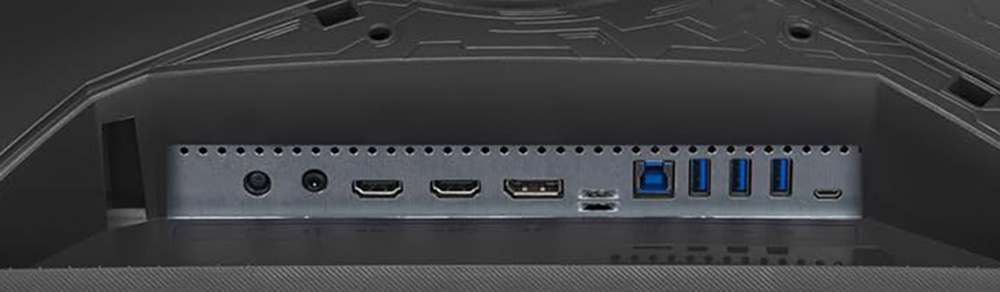
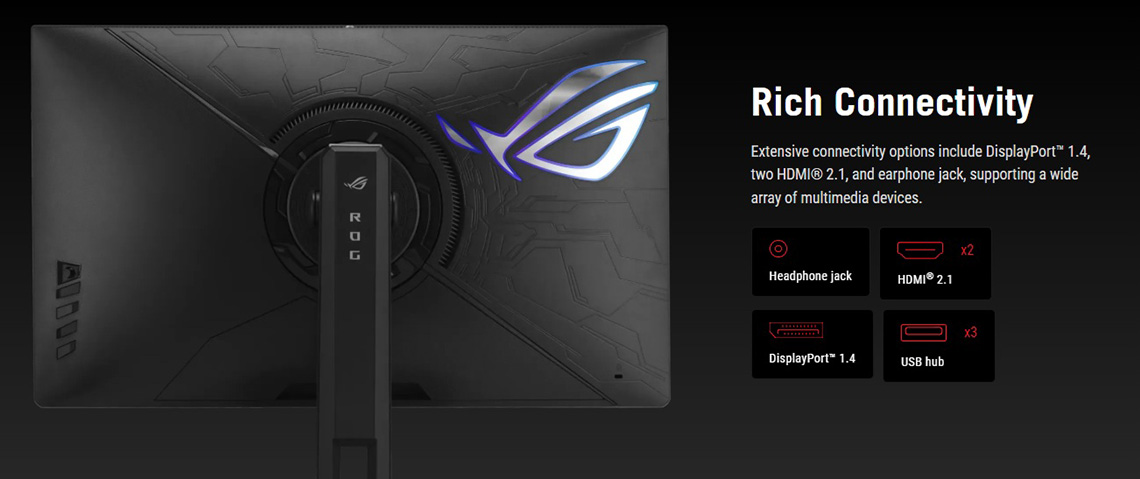
Connectivity is somewhat limited compared with many modern monitors, but still better than previous Native G-sync module screens thanks to the shift to a MediaTek scaler. There’s 1x DisplayPort 1.4 (with DSC) and 2x HDMI 2.1 (40 Gbps) video connections, along with 3x USB-A data ports and a headphone connection. There’s also a micro USB-B port on the back but this is for service only and firmware updates. In the box you will find a DP 1.4 cable but no HDMI, and also (oddly) no USB data cable for the firmware updates. You will need a USB-A to micro-USB cable for that.
There’s no need for any higher spec DP connection here, v1.4 with DSC is more than enough to support this spec, but it would have been nice to see USB type-C included perhaps, something common on many modern monitors nowadays, even gaming displays. That could have also opened up support for a KVM switch function which some people find useful, but that’s also missing here.
We found it a little cramped to get to the video connections sometimes as well, as they are inset a bit at the back with a ledge along the bottom that gets in the way a bit. That makes it a little more fiddly if you plan to unplug and re-plug cables much. Note also that there is an external power brick for this monitor.
Stand ergonomics
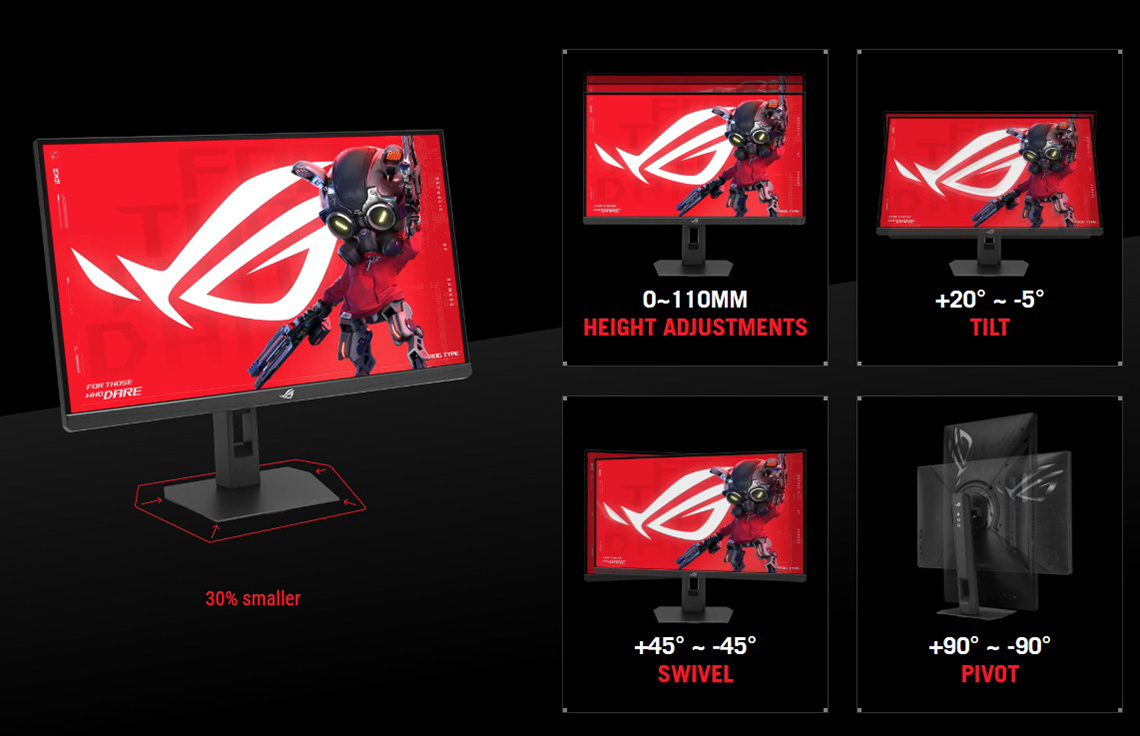
The stand offers a full range of tilt, height, swivel and rotate adjustments. They’re all pretty smooth in operation but tilt is pretty stiff, and rotate is very stiff on our sample. There’s a moderate amount of wobble from the stand as you reposition the screen or when using the control buttons which are on the right hand side at the back.
On-screen menu
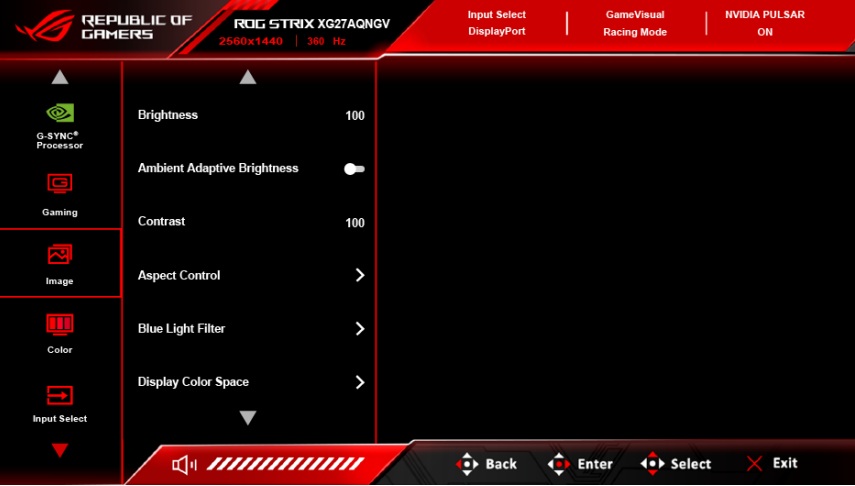
The OSD menu is controlled primarily using a joystick toggle on the back right hand side of the screen, along with 2 pressable shortcut buttons. By default those give you quick access to the Game Visual preset mode menu, and to the Game Plus settings but you can customise them a bit in the menu if you want to some other settings.
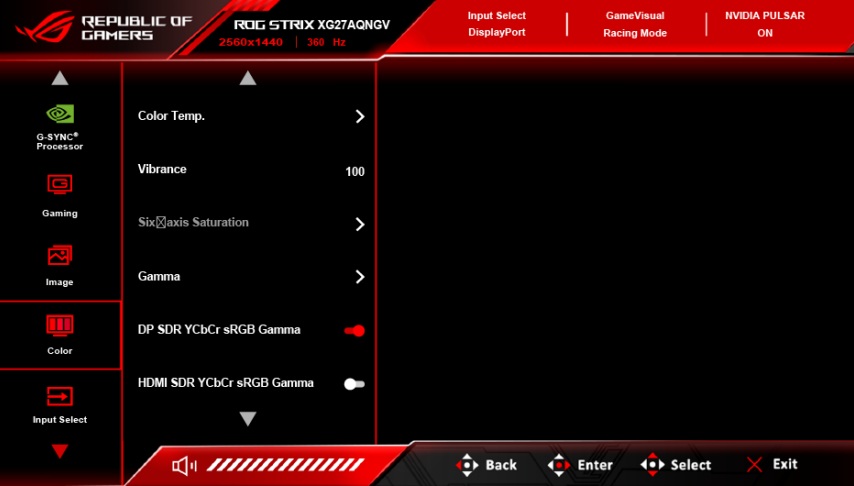
There’s a good range of options and settings available in the menu, although the software is quite large in size we thought. Navigation is quick, easy and intuitive thanks to the joystick toggle though. Note that there is no support for Asus’ DisplayWidget Center software with this screen sadly.
| OSD Menu | |
| Joystick toggle controller |  |
| Quick and snappy | |
| Intuitive to use | |
| User updatable firmware | |
| Asus DisplayWidget Center support |  |
Brightness and Contrast
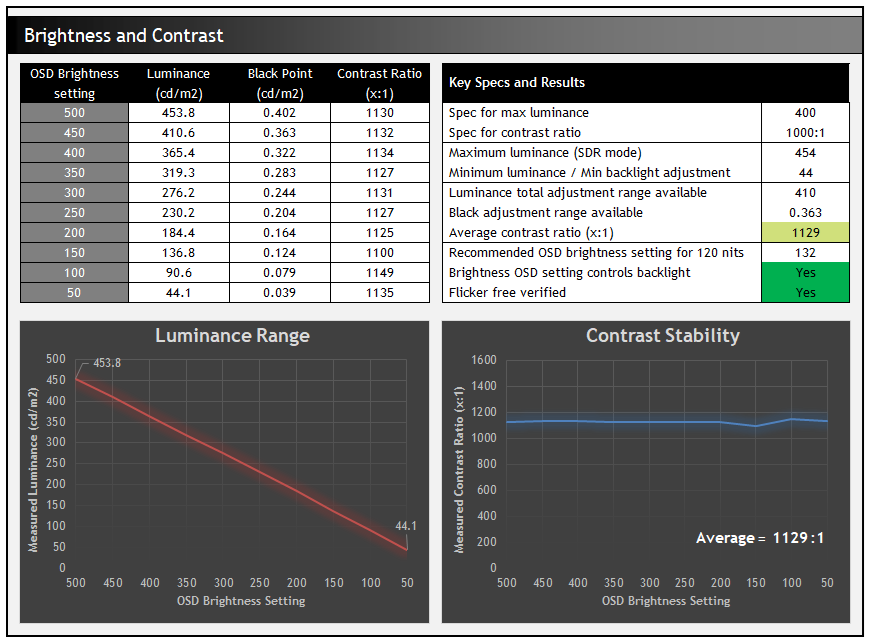
The brightness setting in the OSD menu is a little unusual as it is adjustable between settings of 500 (max) and 50 (min). The adjustment speed is quite slow as well, but there’s a good backlight adjustment range with luminance between 454 and 44 nits available. This slightly surpasses the spec of 400 nits at the upper end of the range, and at the lower end should be adequate for most users in darker room conditions.
The contrast remained stable across the adjustment range and exceeded the 1000:1 spec a little, reaching 1129:1 average which was pretty normal for an IPS-type panel. Some more recent IPS Black panels can reach higher contrast ratios, but those aren’t available at these refresh rates at this time.
Testing Methodology Explained (SDR)

Performance is measured and evaluated with a high degree of accuracy using a range of testing devices and software. The results are carefully selected to provide the most useful and relevant information that can help evaluate the display while filtering out the wide range of information and figures that will be unnecessary. For measurement, we use a UPRtek MK550T spectroradiometer which is particularly accurate for colour gamut and colour spectrum measurements. We also use an X-rite i1 Pro 2 Spectrophotometer and a X-rite i1 Display Pro Plus colorimeter for various measurements. Several other software packages are incorporated including Portrait Displays’ Calman color calibration software – available from Portrait.com.
We measure the screen at default settings (with all ICC profiles deactivated and factory settings used), and any other modes that are of interest such as sRGB emulation presets. We then calibrate and profile the screen before re-measuring the calibrated state.
The results presented can be interpreted as follows:
- Gamma – we aim for 2.2 gamma which is the default for computer monitors in SDR mode. Testing of some modes might be based on a different gamma but we will state that in the commentary if applicable. A graph is provided tracking the 2.2 gamma across different grey shades and ideally the grey line representing the monitor measurements should be horizontal and flat at the 2.2 level, marked by the yellow line. Depending on where the gamma is too low or too high, it can have an impact on the image in certain ways. You can see our gamma explanation graph to help understand that more. Beneath the gamma graph we include the average overall gamma achieved along with the average for dark shades (0 black to 50 grey) and for lighter shades (50 grey to 100 white).
- RGB Balance and colour temperature – the RGB balance graph shows the relative balance between red, green and blue primaries at each grey shade, from 0 (black) to 100 (white). Ideally all 3 lines should be flat at the 100% level which would represent a balanced 6500K average colour temperature for all grey shades. This is the target colour temperature for desktop monitors, popular colour spaces like sRGB and ‘Display DCI-P3’ and is also the temperature of daylight. It is the most common colour temperature for displays, also sometimes referred to as D65. Where the RGB lines deviate from this 100% flat level the image may become too warm or cool, or show a tint towards a certain colour visually. Beneath this RGB balance graph we provide the average correlated colour temperature for all grey shades measured, along with its percentage deviance from the 6500K target. We also provide the white point colour temperature and its deviance from 6500K, as this is particularly important when viewing lots of white background and office content.
- Greyscale dE – this graph tracks the accuracy of each greyscale shade measured from 0 (black) to 100 (white). The accuracy of each grey shade will be impacted by the colour temperature and gamma of the display. The lower the dE the better, with differences of <1 being imperceptible (marked by the green line on the graph), and differences between 1 and 3 being small (below the yellow line). Anything over dE 3 needs correcting and causes more obvious differences in appearance relative to what should be shown. In the table beneath the graph we provide the average dE across all grey shades, as well as the white point dE (important when considering using the screen for lots of white background and office content), and the max greyscale dE as well.
- Luminance, black depth and contrast ratio (static) – measuring the brightness, black depth and resulting contrast ratio of the mode being tested, whether that is at default settings or later after calibration and profiling. We aim for 120 cd/m2 luminance which is the recommended luminance for LCD/OLED desktop monitors in normal lighting conditions. Black depth should be as low as possible, and contrast ratio should be as high as possible.
- Shadow detail – this is evaluated with the screen configured to a 200 nits white luminance for consistency between different monitors, and viewed in a dimly lit room. This first 16 greyscale shades are measured using our UPRTek MK550T spectro device (0.002 nits lower limit) for shades near-black, and the results are plotted on a graph relative to a target gamma curve (usually 2.2 gamma). Where the measurement line crosses the 0.01 nits point on the Y-axis is typically the visual threshold for where we would start to be able to detect luminance compared with black (0.00 nits). We combine these objective measurements with visual tests using a grey shade test pattern to determine the first visible shade, and then rank the shadow detail performance accordingly.
- Gamut coverage – we provide measurements of the screens colour gamut relative to various reference spaces including sRGB, DCI-P3, Adobe RGB and Rec.2020. Coverage is shown in absolute numbers as well as relative, which helps identify where the coverage extends beyond a given reference space. A CIE-1976 chromaticity diagram (which provides improved accuracy compared with older CIE-1931 methods) is included which provides a visual representation of the monitors colour gamut coverage triangle as compared with sRGB, and if appropriate also relative to a wide gamut reference space such as DCI-P3. The reference triangle will be marked on the CIE diagram as well.
- dE colour accuracy – a wide range of colours are tested and the colour accuracy dE measured. We compare these produced colours to the sRGB reference space, and if applicable when measuring a wide gamut screen we also provide the accuracy relative to a specific wide gamut reference such as DCI-P3. An average dE and maximum dE is provided along with an overall screen rating. The lower the dE the better, with differences of <1 being imperceptible (marked by the green area on the graph), and differences between 1 and 3 being small (yellow areas). Anything over dE 3 needs correcting and causes more obvious differences in appearance relative to what should be shown. dE 2000 is used for improved accuracy and providing a better representation of what you would see as a user, compared with older dE methods like dE 1994, as it takes into account the human eye’s perceptual sensitivity to different colours.

Default Setup
The screen comes out of the box in the Racing preset mode, with the full wide gamut of the backlight active. We measured this default mode first of all.
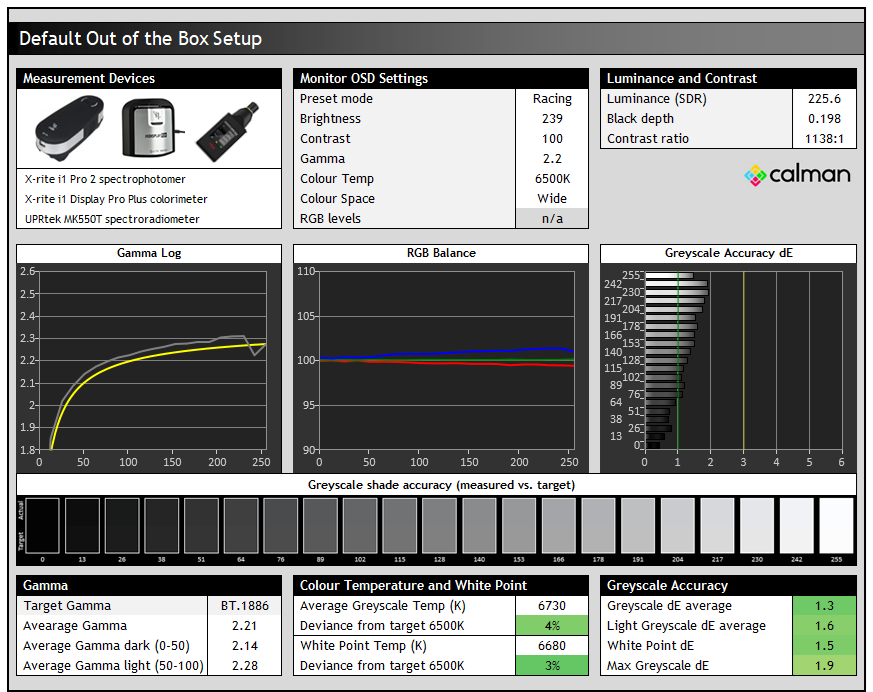
The gamma is configured to the BT.1886 gamma curve instead of 2.2, but follows that curve nicely. There is a setting in the OSD menu for ‘DP SDR YCbCr sRGB gamma’ as well which is supposed to activate an sRGB gamma curve. In practice we couldn’t see any difference between the on and off modes for that setting, it didn’t seem to alter black depth, contrast or anything else in our measurements or visually.
RGB balance was every good as shown on the middle graph, with a very slight weighting towards blue which gave a minor 3% error in the white point, being only slightly too cool. Greyscale accuracy was very good as a result, with average dE 1.3 measured. This represented a very good performance and factory calibration as we’ve become accustomed to from NVIDIA collaboration / G-sync hardware screens.
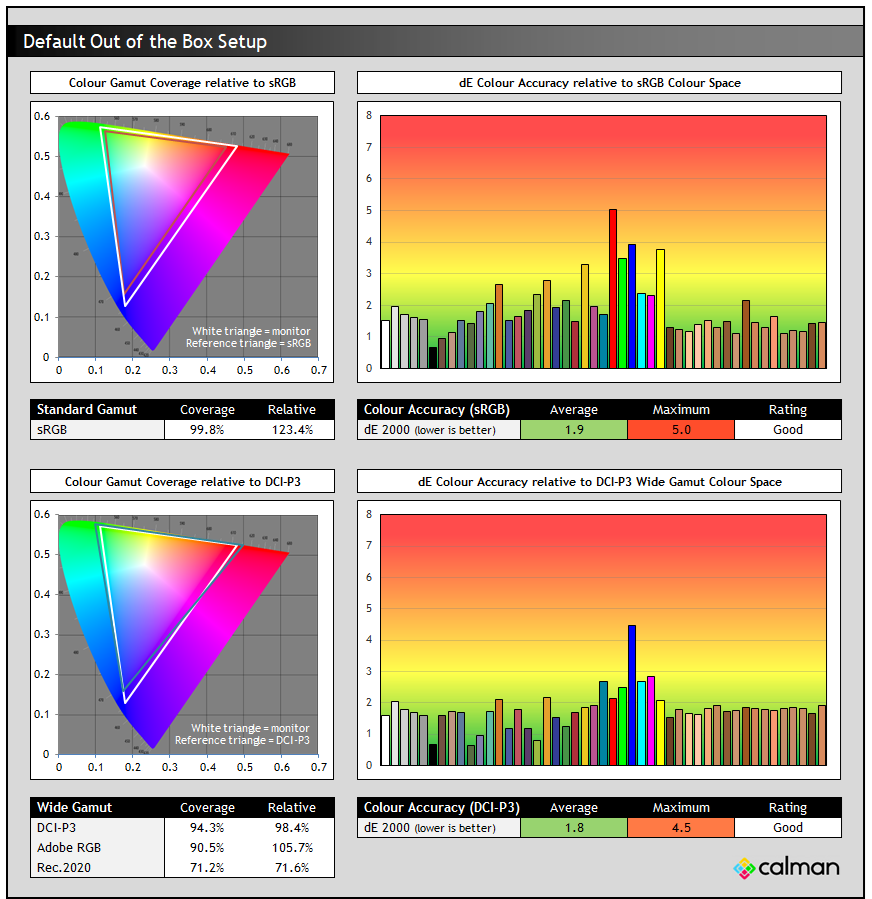
The screen has an extended colour gamut with a 90% DCI-P3 coverage quoted. As a result this extends a fair way beyond the sRGB reference space, giving 123% relative coverage, but colour accuracy for sRGB / SDR colours still remains good, despite the over-saturation in some shades. Colours look a bit more vivid than an sRGB-only screen which many gamers will prefer, although not as vivid as modern OLED and QD-OLED screens. We measured 94% coverage of DCI-P3, so a little beyond the spec, but this is a bit less than many other modern gaming monitors which typically reach up to around 99% coverage of DCI-P3.
Shadow Detail
We also explored and tested the near-black shadow detail which can sometimes be a challenge on low contrast LCD panels like this. The screen was configured to 200 nits white luminance, and we tested the screen in various different modes, with the results remaining consistent in each.
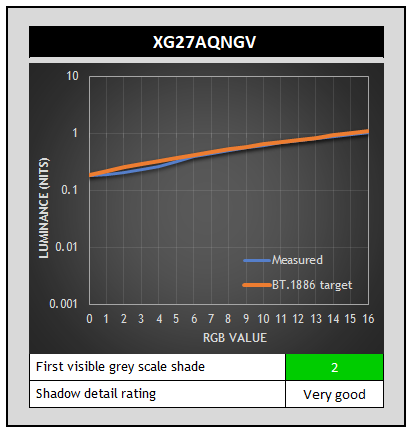
The black depth of the IPS panel can only reach around 0.19 nits and so at no point will any shade be below the typical minimum luminance threshold of 0.01 nits in a dimly lit room (more information on this and the topic of shadow detail in our article here). The first visible grey shade we could make out compared with black was RGB 2 which was very good, with RGB 1 being crushed to black as it was basically the same luminance as the black point. This did offer some strong shadow detail for darker content which is good, but of course you get a low overall contrast ratio and raised black because it’s an IPS LCD panel, compared with VA and OLED panels. The shadow boost setting in the menu helps brighten darker grey shades quite well too, and could be useful for some darker gaming situations.
sRGB Emulation mode
Asus do provide an sRGB preset mode within the ‘Game Visual’ menu, but this has a locked brightness (reaching 123 nits) and so it not the best approach to clamping the colour space back to the sRGB reference space, and reducing the extended gamut of the backlight. Instead, there is a much easier and more flexible approach, which is to simply switch the ‘color space’ setting from wide gamut to sRGB. That leaves all other settings available, so you can still change gamma, colour temp, brightness, contrast etc should you wish. Oddly this setting is in the ‘image’ section of the OSD menu, instead of the ‘color’ section which seems an odd choice.
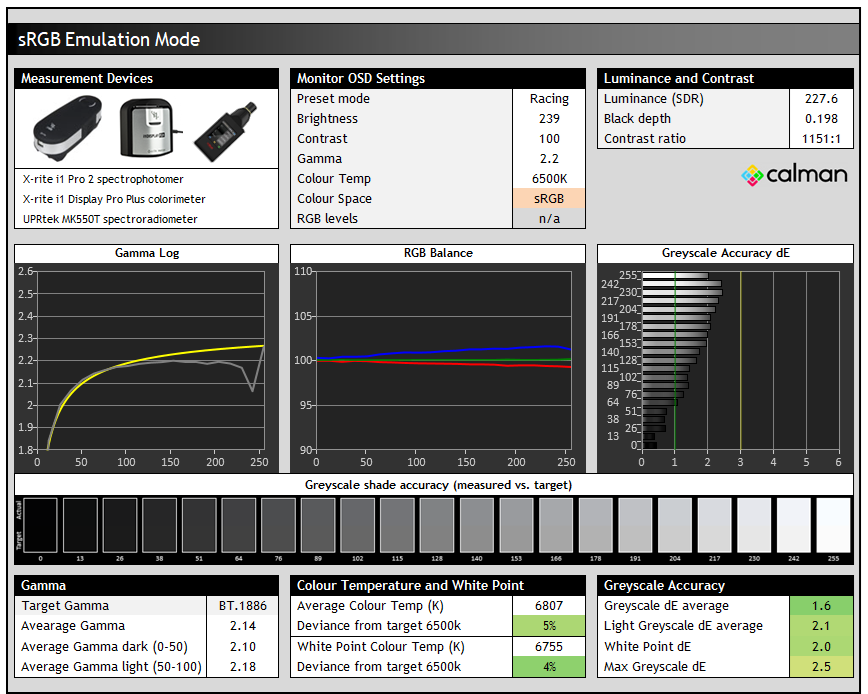
There’s no change to the gamma, RGB balance, colour temp or greyscale of note, it remains the same as before as we’ve only changed the colour space setting.
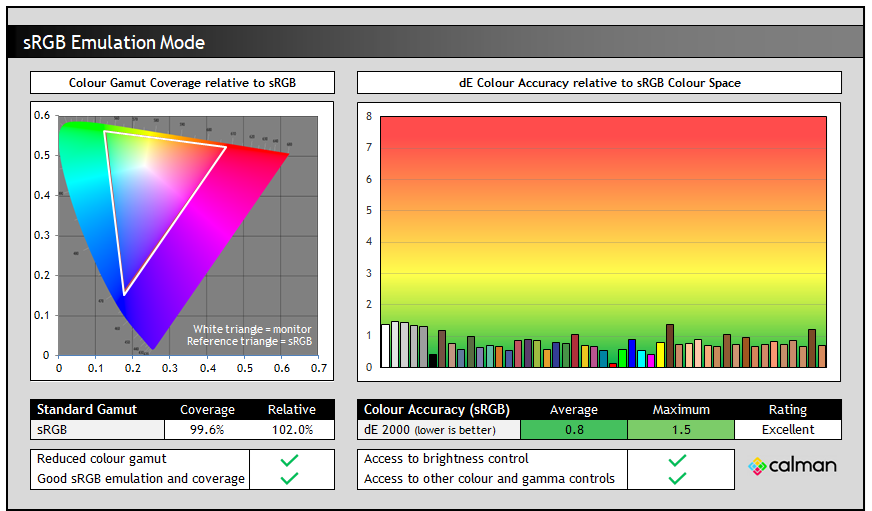
The main difference though is that the colour space has been clamped back very close to the sRGB reference now as intended. This leaves us with excellent colour accuracy for sRGB colours as well, with a dE 0.8 average. This is an extremely well calibrated sRGB emulation mode which is great news, and still leaves you with full control and access to all the other settings. This is how an sRGB emulation mode should work!
Calibration
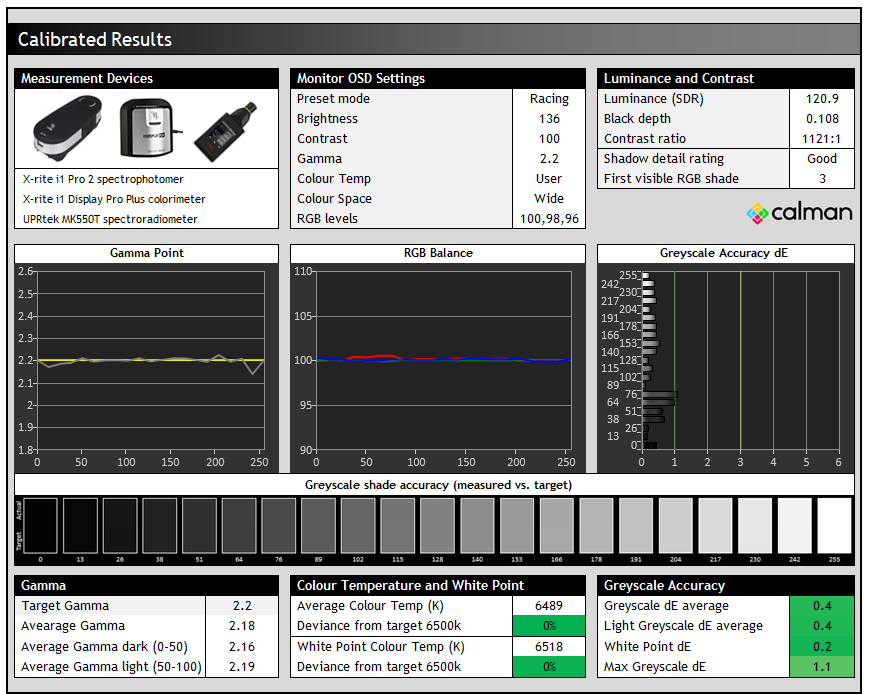
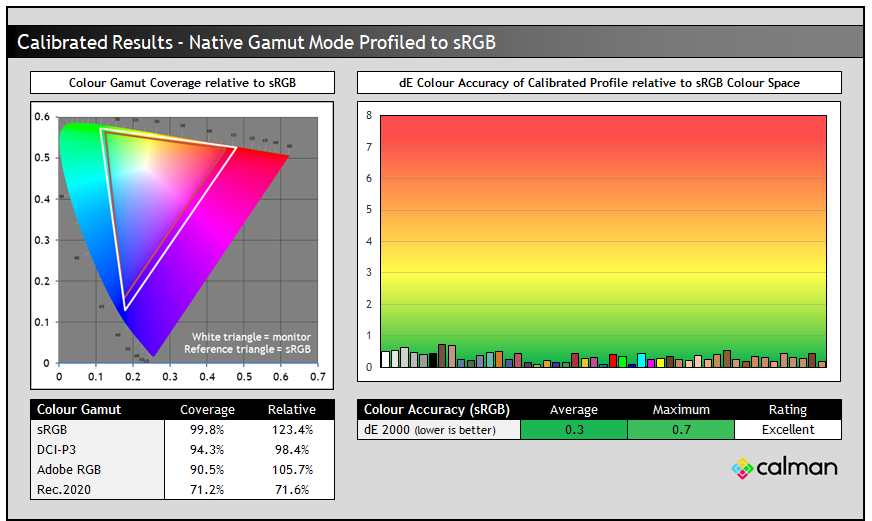
Calibration and profiling can produce some very good overall results and could be useful though if you wanted to operate the screen within its native wide gamut mode, but then map the colour space back to something else like sRGB for instance for colour-aware applications (e.g. Photoshop). You would need a suitable calibration device and software for this, or you could also try our calibrated ICC profile.
The screen was profiled to 2.2 gamma, 6500K colour temp and to the sRGB colour space. The screen was left in its native wide gamut mode, but this profile will be used in colour-aware applications to map back to sRGB in this instance. Overall the calibrated results were excellent as you’d hope.
Get the best settings for this screen
- On our Patreon Insider tier and above you can find our full ‘Best settings guide’ for this screen which includes all our recommended calibrated settings and ICC profile for SDR mode, as well as other best settings guidance for other options and gaming.
- If you only want just our standard SDR settings and calibrated profile, that is available via our ICC database (without all the other best settings guide).
ICC Profiles and Monitor Calibration Database
Find the recommended settings and a calibrated ICC profile for your display.
[View here]
General and Office
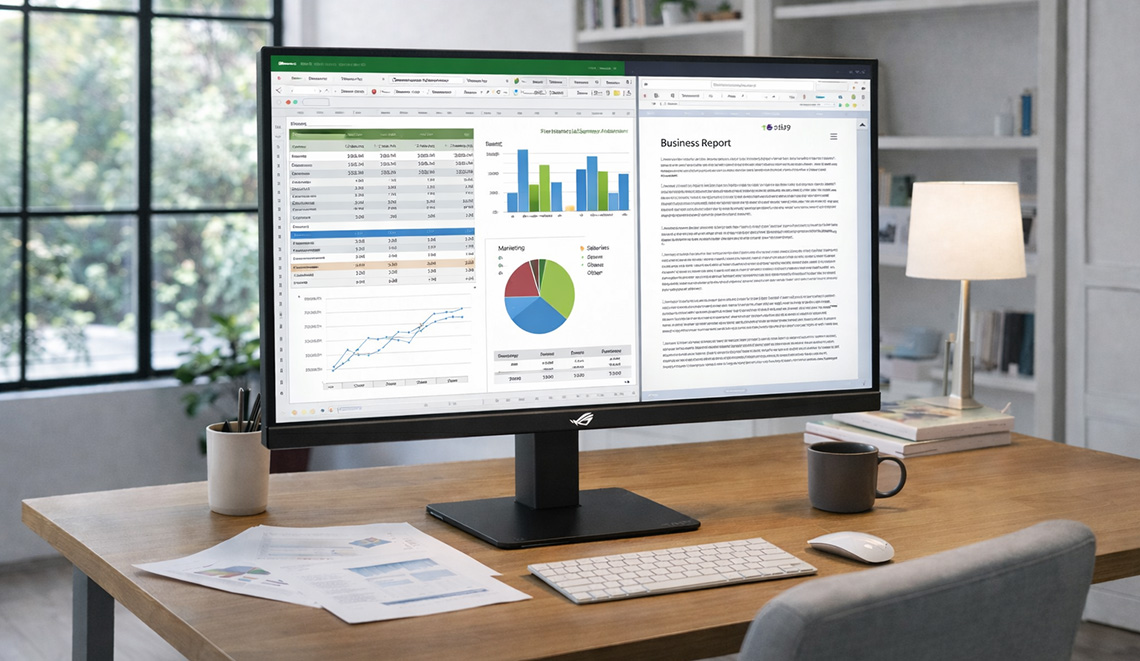
The IPS-type panel used for this screen offers decent all round performance including wide viewing angles and a stable image quality that you’d expect from this technology. Being an IPS panel the viewing angles are good, but there’s familiar pale “IPS glow” when viewing darker content from an angle as with the vast majority of IPS panels. Overall it offers wider viewing angles and better overall image than VA and TN Film panels.
Being an LCD, you don’t have to worry about image retention and burn-in like you do with OLED panels. That’s important for office monitors like this which are going to be used typically for a lot of static content and work. It also features a standard RGB sub-pixel layout like nearly all LCD’s do, so you don’t have any text clarity concerns like you might on OLED panels too.
The resolution of 2560 x 1440 is standard on a 27″ sized screen and is comfortable without scaling being required, providing a decent desktop space for multi-tasking and split screen work. Higher pixel densities from 4K and 5K resolutions are available in this size, but not with G-sync Pulsar. The lower 1440p resolution is more suitable for fast-paced gaming, being a lot easier to power than 4K+. The screen has a light matte anti-glare (AG) coating which is the same as other modern IPS LCD panels.
Backlight dimming
Brightness = 259
Brightness = 170
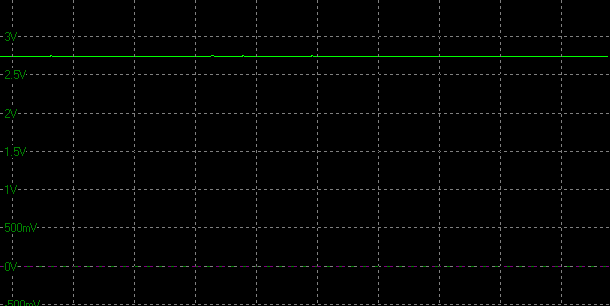
Brightness = 100
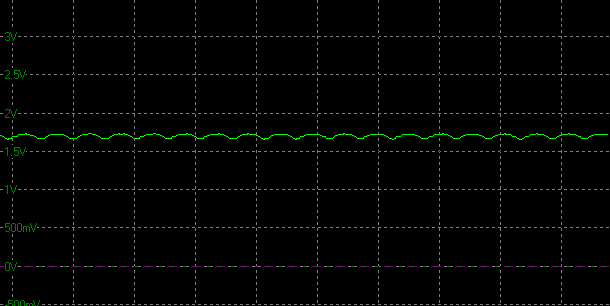
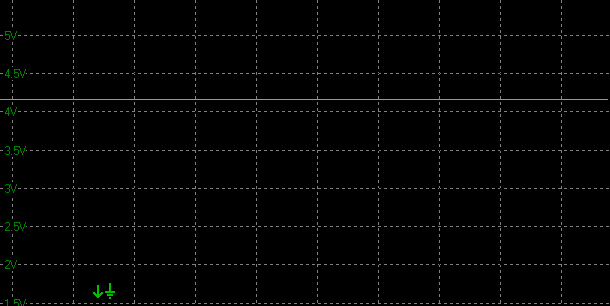
We measured the backlight operation with an oscilloscope. For all brightness settings above 170 in the menu we observed a flat line with DC dimming used for the backlight. Below the 170 setting a very low amplitude oscillation appears at a 48Hz frequency, but it is such a minor fluctuation that this shouldn’t present any flicker problems or cause any issues for the vast majority of users. The screen would still be considered flicker free.
Blue Light
Blue Light Filter = Off
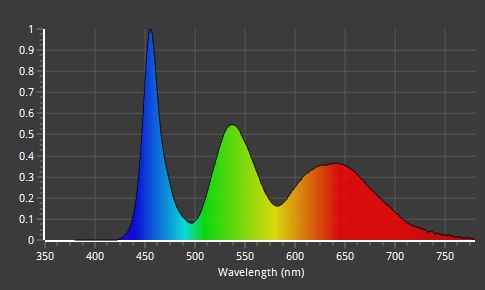
| Blue light output | |
| Blue peak wavelength | 455 nm |
| Blue light portion | 27.79% |
| Low blue light modes available | Levels 1 – 4 |
| Low blue light mode temp | 5651K – 4516K |
Blue Light Filter = Level 4
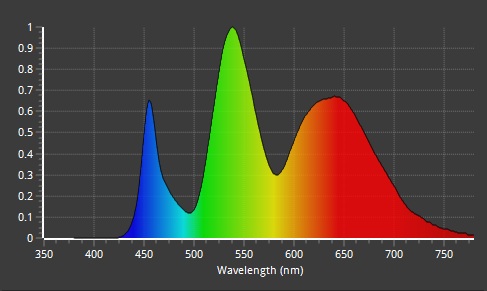
| Blue light output | |
| Blue peak wavelength | 455 nm |
| Blue light portion | 13.42% |
| Measured white point | 4516K |
| Brightness adjustable | (only in levels 1 – 3) |
The spectral distribution at a calibrated 6500k is shown above, with the blue peak measured at 455 nm wavelength and a 27.79% blue light percentage. There some ‘Blue Light Filter’ settings in the menu which offer some warmer colour temps. Levels 1, 2 and 3 are all pretty similar to one another visually, not really altering the blue peak at all, but you retain access to all other screen settings when using those modes.
The Level 4 setting reduces the blue peak a lot, but the image is very warm and yellow in appearance, and it also has a locked brightness control, reaching ~215 nits fixed luminance.
- Level 1 = 5651K white point
- Level 2 = 5590K white point
- Level 3 = 5486K white point
- Level 4 = 4516K white point (with locked luminance at ~215 nits)
Feature set
| Features | Notes | |
| USB type-C connectivity (DP Alt mode) | | |
| USB type-C power delivery | | |
| Daisy chaining support | | |
| KVM switch | | |
| PiP and PbP support | | |
| USB data ports | | 3x USB-A ports |
| Easy access USB data ports | | |
| Integrated speakers | | |
| Audio output / headphone out | | 1x connection |
| Mic input | | |
| Integrated webcam | | |
| Ambient light sensor | | inc NVIDIA Ambient Adaptive |
| Motion sensor | | |
| Stand adjustments | | Tilt, height, swivel, rotate |
| VESA mount support | | 100 x 100mm |
| Integrated power supply | | External ~15 x 7 x 2.5 cm |
| Tripod socket | | |
| Firmware updates | | Supported |
| Fan-less design | |
Since this is a screen aimed at gaming primarily, there’s a limited range of extra features as you might expect. The most notable omissions in todays market are USB type-C video connectivity, KVM switch and PiP/PbP support which are increasingly common on higher end gaming screens. However, there are 3x USB-A, a headphone connection and an ambient light sensor which could be useful to some people. The stand is fully adjustable too.
Ambient Adaptive technology
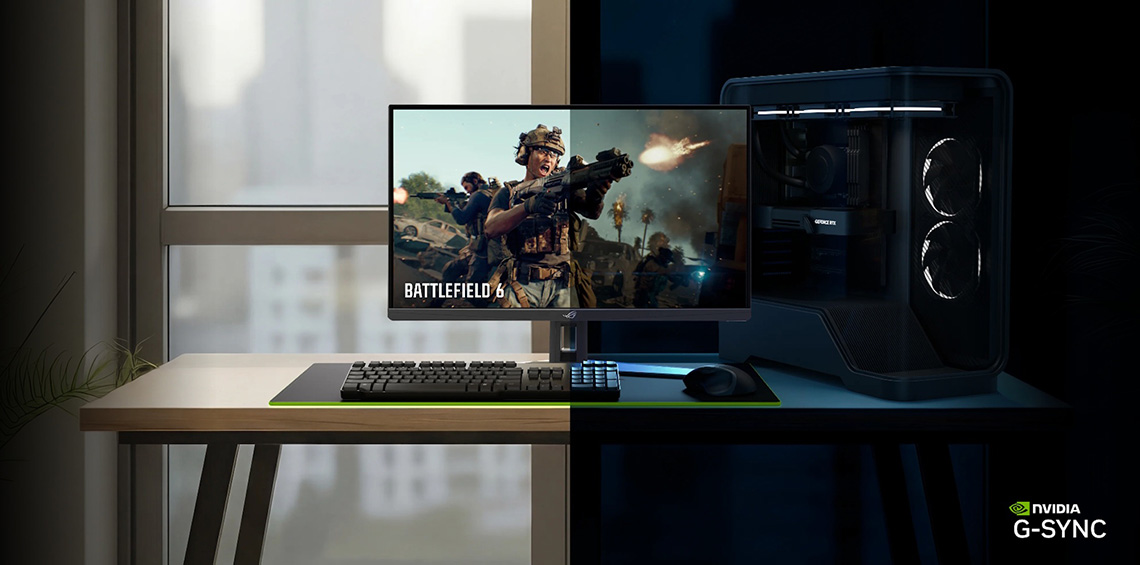
The G-Sync Pulsar monitors launched during Q1 also include another new feature called ‘G-Sync Ambient Adaptive Technology’. This utilizes a built-in light sensor (on the top of the monitor in the case of this Asus screen) to give users the option to automatically tune colour temperature and/or brightness based on the ambient lighting in the room, for optimal viewing at any hour of the day or night. You can “avoid being blinded at night, and ensure you see enemies even on the brightest days, without having to manually change your monitor settings throughout the day.” This seems to work quite well, responding nicely to changing ambient light conditions and adjusting the image accordingly.
Gaming

The XG27AQNGV is aimed primarily at gamers and it’s key feature is of course the new NVIDIA G-sync Pulsar technology. We won’t repeat all the technical information here, so if you want to know everything about Pulsar, how it works, how it was developed and what might be next for this exciting new gaming technology – check out our full detailed article.
NVIDIA G-sync Pulsar Explained and Explored
An in depth look at NVIDIA G-sync Pulsar, how it works and the benefits it can offer to motion clarity for gaming.
[View here]
We will provide a good overview though for the completeness of this review. NVIDIA G-sync Pulsar is the company’s latest innovation which combines their proprietary strobing blur reduction technology (ULMB 2) with Variable Refresh Rates (VRR) for the first time, offering gamers a killer combination for an impressive gaming experience. Not only does it offer blur reduction and VRR at the same time, but it combines all the following innovations and display capabilities in to a single solution:
- Strobing blur reduction operation, akin to ULMB 2
- G-sync VRR support
- Rolling-scan backlight operation
- Finely tuned panel overdrive control for optimal response times
- Variable overdrive, controlling response times and overshoot levels as frame rate varies
- Vertical-dependent overdrive to optimize response times for different sections of the screen when strobing is used
We will examine the performance when using Pulsar in a moment, but if you want to know more detail about how the strobing works, the rolling-scan backlight and everything else, please check out our full article.
The latest firmware update
During our testing NVIDIA released a new firmware for the 4 Pulsar monitors, which is v1.1.4 from their point of view. According to the firmware update process our unit was originally running v1.0.6 which was the version before that, although in the Asus OSD menu it was labelled as (their firmware) MCM101. After the update, that now shows as MCM102.
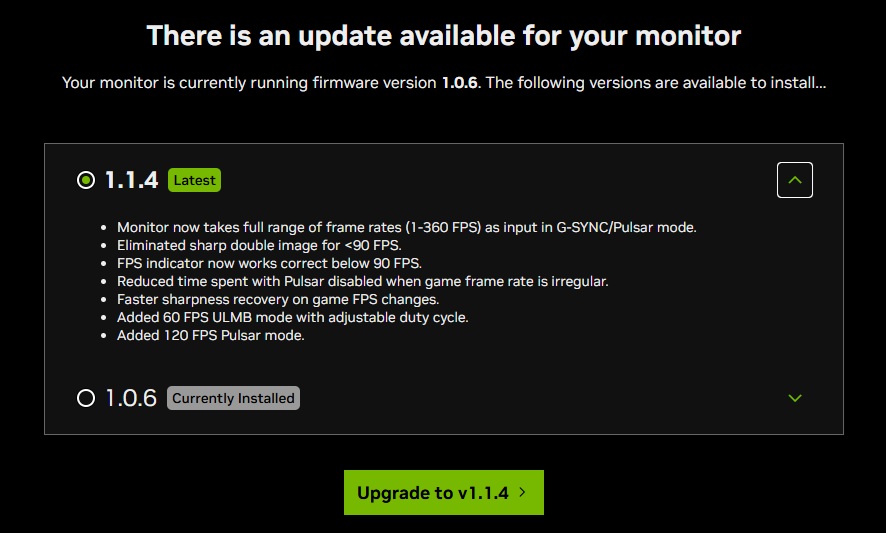
Anyway, this new firmware provides a range of gaming and Pulsar-related updates and improvements which we will talk about in the following sections. The process itself was super-easy by the way, it’s done via a browser interface from the NVIDIA website and you just need to have a USB cable connected between the monitor’s service port and your PC. You enter the firmware update mode in the on-screen menu, and follow the steps on the screen. It took around 5 mins to complete although we had to find our own USB-A to micro-USB cable as Asus don’t provide one in the box for some reason.
Refresh Rate
| (at native resolution) | Refresh Rate |
| Maximum Refresh Rate DisplayPort | 360Hz |
| Maximum Refresh Rate USB type-C | n/a |
| Maximum Refresh Rate HDMI | 120Hz |
| VRR range | 1 – 360Hz (after firmware update) |
| VRR certifications | (native) NVIDIA G-sync |
| ClearMR certification tier | |
There is a 360Hz refresh rate which is still a high spec for an LCD monitor, although lower than all the very high refresh rate OLED monitors around now. Native G-sync capabilities allows for support of variable refresh rates (VRR) from compatible NVIDIA systems, but VRR can also be used from AMD systems too. Note though that G-sync Pulsar only works with a G-sync GPU though. Note that the HDMI connection is limited to 120Hz max at this time, with timings to support native 1440p but also “virtual 4K” resolutions which is useful for consoles.
We say “native” G-sync, since this screen uses the new G-sync-enabled MediaTek scaler, a replacement to the older Native G-sync hardware module you may be familiar with.
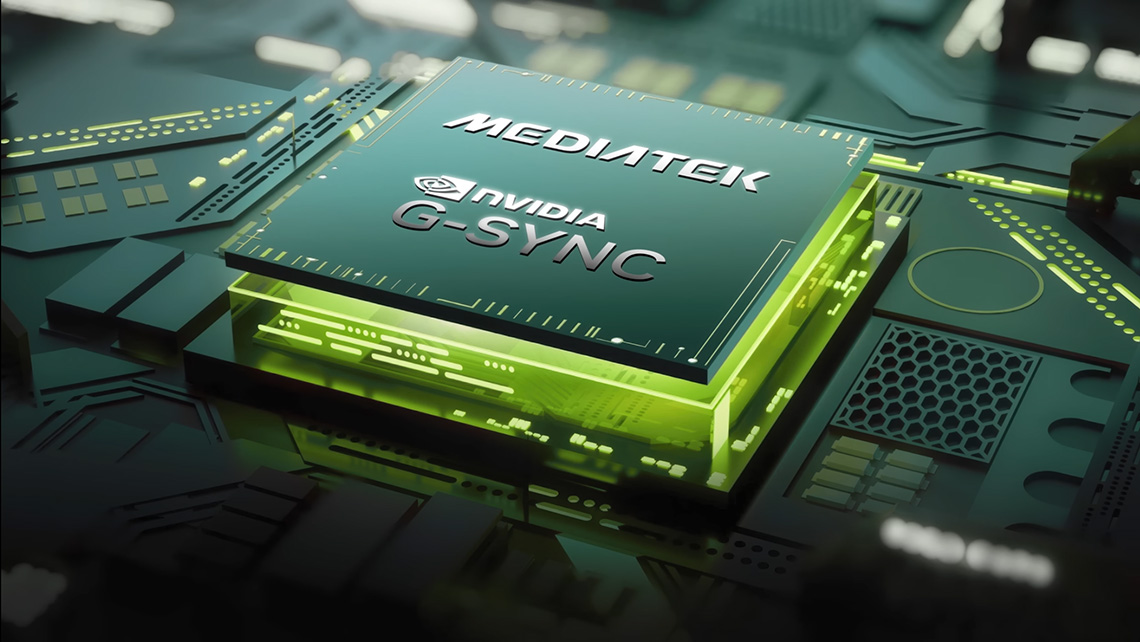
By using mainstream scalers and embedding their G-sync capabilities into those, it’s possible to reduce costs (the old module was expensive), potentially bring capabilities to more displays (the MediaTek scalers are widely adopted), and they’re no longer sacrificing connections and other features like they did with their own module. The Asus screen we are testing here can offer 2x HDMI 2.1 connections for instance which were not available on any of the earlier Native G-sync modules. Now NVIDIA no longer need to develop and produce their own in-house module to get G-sync features working, so this is a positive step forward.
Firmware update v1.1.4 fixes LFC behaviour
At the time of our original testing the screen, the available VRR range was 75 – 360Hz, with LFC used below that. This did however create some problems with Pulsar behaviour as when LFC kicks in and the frame rate gets multiplied, the screen sees you as running a frame rate >75fps again, and activates Pulsar. However, with LFC being used it leads to loads of ghost images and cross talk problems. This was even more noticeable when you set the lower limit to 75fps instead of 90fps, as Pulsar remained active nearly all the time, but at anything lower than 75fps, LFC caused loads of artefacts and ghosting images.
The firmware update provided during the course of our testing fixed the LFC behaviour and opened up the full intended 1 – 360Hz VRR range from the driver instead. LFC is not used at any frame rate any more, and so Pulsar deactivates at the correct lower frame rate as intended.
Gaming extras
| Other Features | |
| Overdrive settings | Off, Normal, Esports, Extreme, User |
| Variable overdrive support | |
| Single overdrive mode experience | |
| Motion blur reduction mode | G-sync Pulsar (with VRR) ULMB 2 (at fixed refresh rates) |
| Dual-mode support | |
| Gaming extras | Gaming preset modes FPS counter Crosshair Timer Stopwatch Display Alignment Dark Boost |
| Emulated gaming sizes | 25″ (default and stretched modes) |
There’s a lot of gaming extras on offer as well including the G-sync Pulsar strobing blur reduction backlight mode (tested in a moment), loads of extra settings like crosshairs, FPS counters etc. There are also a couple of simulation modes for a smaller screen size, labelled as 25″ default and 25″ stretched in the menu.
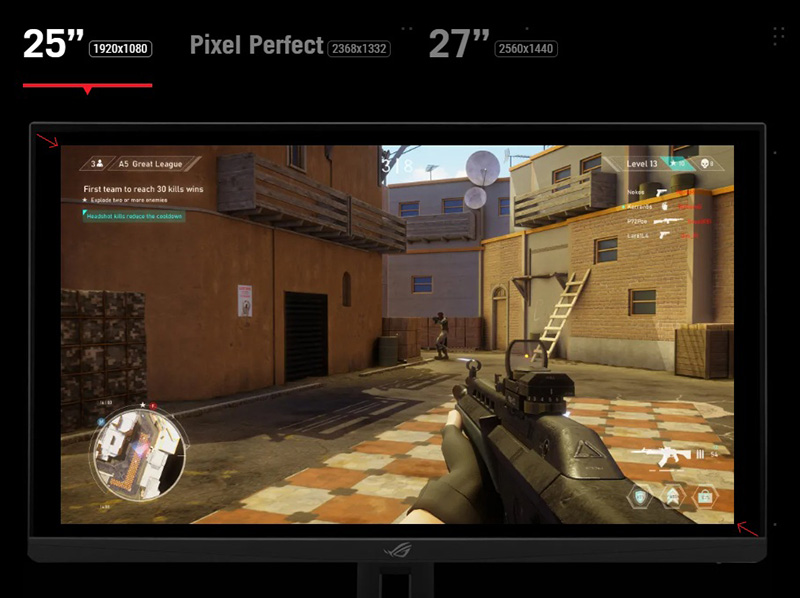
- If you enable the “25” default” mode in the menu you get a smaller 16:9 aspect ratio screen area to focus on with black borders around the edges, and the native resolution switches to 2368 x 1332 (with 1:1 pixel mapping). You can also set this to 1920 x 1080 if you’d rather prioritise frame rates than resolution at this size, but the image won’t look as crisp and sharp as you don’t have 1:1 pixel mapping.
- The “25” stretched” mode actually switches to a 4:3 aspect ratio, with the resolution now set to 1776 x 1332 instead, again with 1:1 pixel mapping.
HDR capabilities
We will only briefly mention HDR as there are very limited HDR hardware capabilities on this screen. It’s an LCD panel and has no HDR local dimming, not even edge-lit which could have offered enhanced contrast. It has a peak brightness spec of 500 nits, can support a 10-bit colour depth and has a wide colour gamut (~94% DCI-P3) so there’s some colour capabilities there, and while the screen can accept an HDR10 input signal the capabilities are very limited. If you want a screen more capable of supporting HDR gaming and content, you’d be better looking at an OLED monitor for sure.
Response Times
Before we get in to our measurements, we’ll briefly talk about the IPS panel used in this screen. It’s promoted as “The Fastest Response Time Of All 1440p Monitors“. According to the Asus website, 3 key features define the ‘Ultrafast IPS’ technology that gives the it the fastest response time ever.
- New liquid crystal – A new kind of liquid crystal offers higher birefringence and lower viscosity, allowing the liquid crystals to twist quickly and make space for light to pass through.
- Optimized Orientation – The flow pattern of the new liquid crystals has been optimized for efficiency. Previously, the crystals were lined up parallel to the polarizer surface. The new arrangement allows the liquid crystals to turn faster for a faster response time.
- Dual-Layer Voltage Driver – Conventional displays use a single-layer voltage driver to twist the liquid crystals from the upper left to the bottom-right corner. The XG27AQNGV features a new dual-layer voltage driver design, so the liquid crystals twist from the upper-left and bottom-right corners simultaneously for a smoother, more consistent image.
As discussed in our detailed article about Response Time Testing – Pitfalls, Improvements and Updating Our Methodology we are using an improved and more accurate method for capturing G2G response times and overshoot, based on figures that are more reflective to what you see visually on the screen in real-World usage. Our article linked above talks through why this is better and how we arrived at this improved method in much more detail.
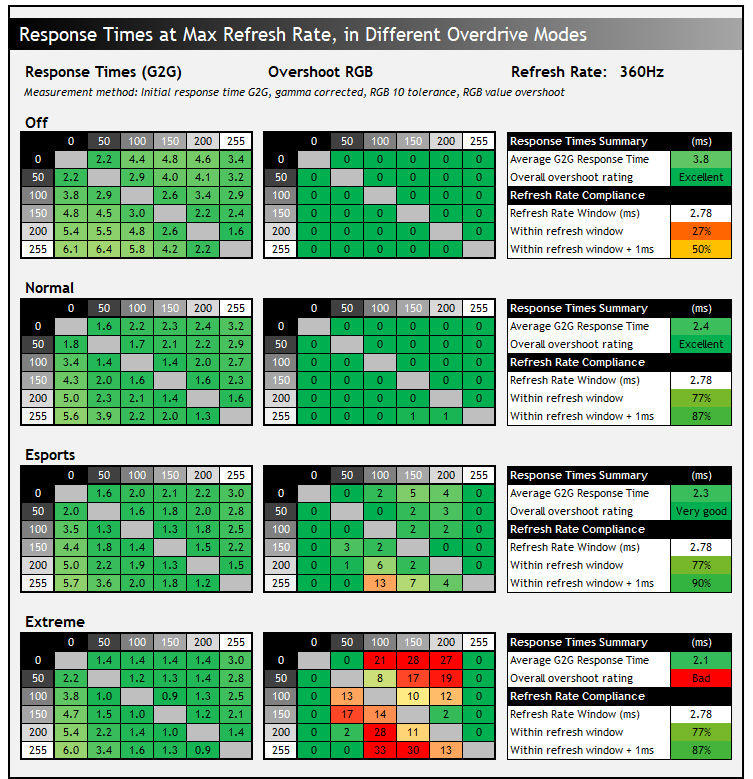
We measured the response times and carried out various visual tests first of all at the maximum 360Hz refresh rate, while using the screen in each of the available overdrive modes. There’s a decent improvement as you move from the ‘off’ mode to the ‘normal’ mode, with response times improving from 3.8ms to 2.4ms G2G average, which improves motion clarity a little and reduces some minor smearing you see in the off mode. That is all without any noticeable overshoot being introduced which is excellent news and the response times were really impressive for an IPS-type panel.
The Esports mode doesn’t change things much, with a very small improvement in G2G times, but a little bit of overshoot starting to creep in with some transitions. The Extreme mode pushes things further but at the cost of some noticeable pale halos and overshoot artefacts on moving content. The normal mode seems to provide the best overall performance and balance we felt, avoiding any potential slight overshoot.
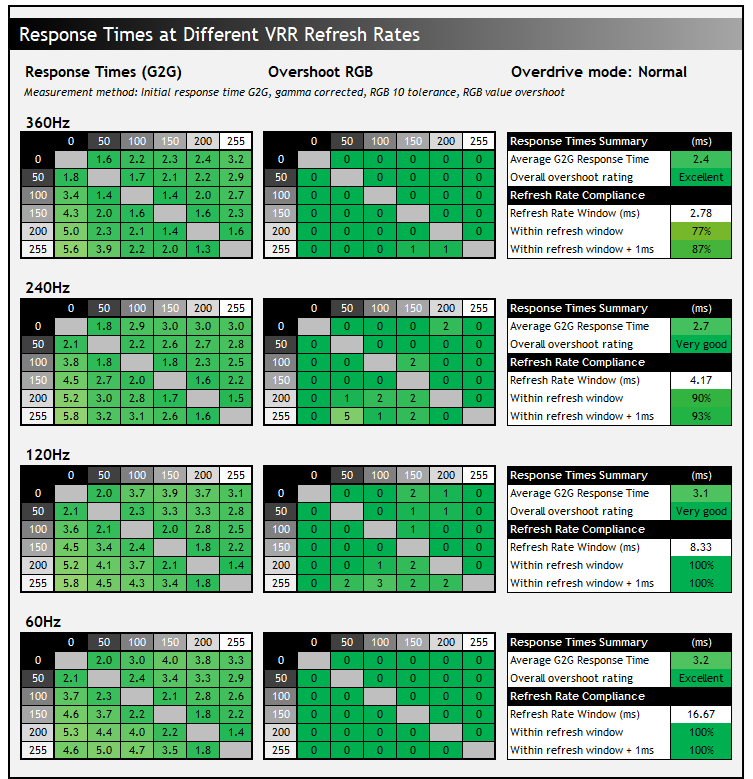
Having settled on the normal OD mode we measured the response times during VRR situations at various different frame rates. Thanks to the G-sync scaler (the new MediaTek scaler with G-sync capabilities added), we have a true variable overdrive feature which controls the overshoot as frame rates reduce. You can see the G2G speeds are slowed down a little in order to ensure no overshoot appears, and this does an amazing job here. This gives you a single overdrive mode experience and variable overdrive which is great to see and a key benefit of the G-sync scaler.
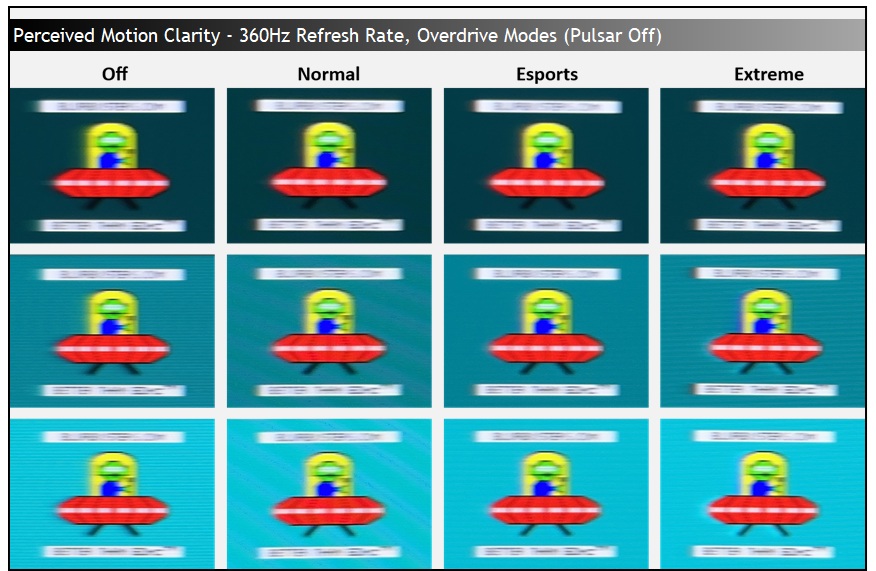
Pursuit camera photos were taken at 360Hz to capture the real-world perceived motion clarity in each overdrive mode. We’ve updated these pursuit camera tests to use a faster 1920px/sec scroll speed which can help capture the differences visible between modern super-high refresh rate displays. Our thanks to Mark at Blurbusters.com for advice on updating our testing methodology. You can see the improvements in smearing as you move up from the Off mode to Normal/Esports, and then the pale halos from the overshoot that start to appear in the Extreme mode.
NVIDIA G-sync Pulsar Testing
As a reminder, if you want to know everything about G-sync Pulsar, how it works, how it was developed and what might be next for this exciting new gaming technology – check out our full detailed article linked below.
NVIDIA G-sync Pulsar Explained and Explored
An in depth look at NVIDIA G-sync Pulsar, how it works and the benefits it can offer to motion clarity for gaming.
[View here]
Pulsar activation and operation
Enabling G-sync Pulsar is really simple, you enable G-sync from your NVIDIA control panel and then just activate Pulsar from the OSD menu and it just works. You don’t need to worry about disabling VRR or be concerned with the (varying) frame rates you experience during games as the strobing will be adjusted and aligned to your ever-changing frame rates dynamically and automatically. It’s super easy to activate and use.
Note that G-sync Pulsar is only available when you’ve using a compatible NVIDIA GPU, it cannot be used from competing brand graphics cards like AMD for instance. VRR works, but Pulsar doesn’t. NVIDIA tell us that “a stable operation of Pulsar requires fine tuning in the driver, which is only available with G-SYNC enabled on GeForce GPUs…It’s related to frame pacing and frame delivery.” That provide a technical explanation at this time and it’s hard to know if in the future anything will change here.
If you’ve disabled VRR / G-sync from the NVIDIA control panel and are gaming at a fixed refresh rate, or you’re using a non-NVIDIA GPU, then ULMB 2 blur reduction mode is available in some configurations instead which we will cover in more detail below.
‘Pulsar Low FPS’ control
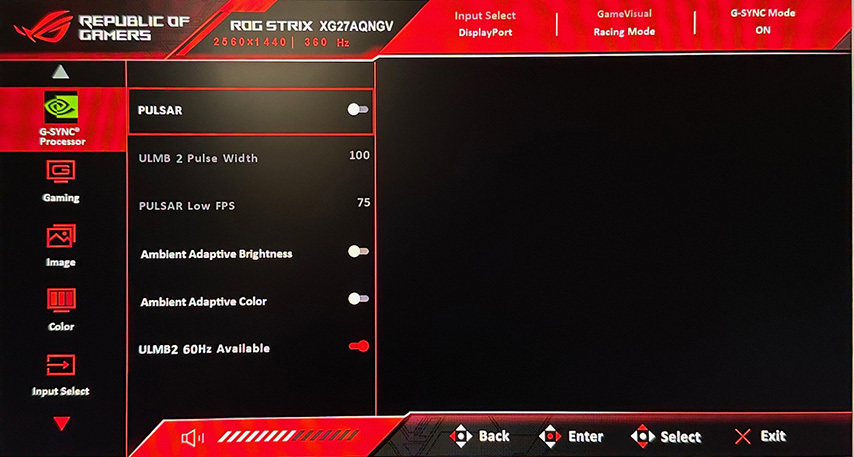
The only additional setting for G-sync Pulsar operation other than an on/off toggle is a user adjustable setting called ‘Pulsar Low FPS’. It adjusts at which frame rate Pulsar turns off to prevent perceived flicker at the lower end of the refresh rate range. By default, it is set to turn off at 90fps but can be turned down as far as 75fps if you want. Note that this is the frame rate that it turns off at, so if set to 90fps it will mean Pulsar remains active from 91 – 360Hz, and turns off at 90fps and below.
NVIDIA consider 90fps to be an optimal lower limit, with some potential for flicker for anything lower down to 75fps. We saw more noticeable visual flicker when frame rates were in the 75 – 85Hz range in our usage, but sensitivity will vary.
That is a hard cut off point at which Pulsar turns itself off at the bottom end, and you may occasionally see a brief flicker when you cross that threshold point, and the motion clarity certainly then takes a big hit. You’ll probably want to consider what your achieved frame rates are in practice to avoid crossing this point as much as possible, perhaps lowering the fps limit if you are finding you’re crossing the 90 fps point regularly.
Also note that it doesn’t instantly turn back on again when you go back above the threshold. For instance if you have the fps limit set at 90 then when you reach 90 fps it will turn Pulsar off, but it won’t immediately turn back on at 91 fps. It usually requires a short sustained period where you’re above the fps limit again before the screen is comfortable that you’re consistently back within the Pulsar range, and turns it back on for you. This is again to avoid constant flickering and switching if you were hovering around the frame rate limit point.
No further change to the lower FPS limit for Pulsar planned
At one point there was mention of NVIDIA extending this lower limit down to 48fps via a future firmware update, but we’ve been told that the extra flicker during VRR Pulsar operation has made this unusable. Instead, and since the main interest in lower frame rate support was for enthusiast 60Hz ULMB operation, they’ve introduced a fixed refresh rate 60Hz mode for ULMB 2 instead as you can see in the new menu screenshot above. Pulsar will remain with a 75fps lower limit as it is now.
G-sync Pulsar Performance
We won’t go through all the detail in this review about how the strobing/pulsing works, but you can check out our detailed NVIDIA G-sync Pulsar article for all that information and testing. We will look more at the motion clarity benefits when using this technology in this review and discuss the benefits for gamers.

First up let’s compare the motion clarity at 360Hz with Pulsar (or ULMB 2) enabled using the familiar TestUFO tools which we configured via a method that allowed us to use them at the same time as VRR, to thoroughly test Pulsar behaviour. Like earlier, we used a faster 1920px/sec scroll speed for the UFO tests which can help capture the differences visible between modern super-high refresh rate displays.
You can see major improvements in perceived motion clarity as you track moving objects across the screen and the improvement is drastic when you enable Pulsar. Moving objects are far sharper and much clearer to track and we were really impressed. This helps make even small details like the scrolling text easy to see. There’s some minor crosstalk ghosting behind certain parts of the image, most visible on darker backgrounds, but in practice and in normal gaming situations this is very hard to see and at low levels. This improves a bit as the refresh rate lowers too.
The motion clarity you can experience here is the equivalent of a theoretical 1,440Hz display as Pulsar can deliver 4x the motion clarity of its native refresh rate. That’s all without needing to power frame rates that high too, you “only” need to be able to push up to 360fps to achieve that insane motion clarity. With a 1440p resolution that’s already a challenge for many systems, but regardless of the frame rate you achieve, you’re going to get a big boost in perceived motion clarity thanks to the strobing backlight.
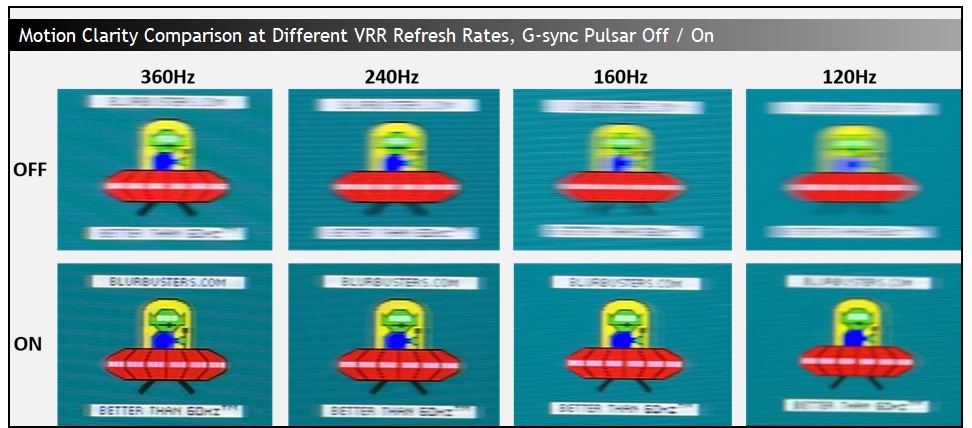
The benefits of Pulsar are even more drastic at lower frame rates compared with the off mode. You get some small reduction in motion clarity as frame rate lowers from 360fps to 120fps with Pulsar enabled, but the moving images were still sharp and crisp. If you turn Pulsar off, the perceived motion blur increases drastically as frame rate lowers due to the sample and hold nature of the LCD panel and the slower frame times. So the benefits of Pulsar extend across a wide range of refresh rates, even at lower fps.
In addition to the TestUFO photos provided above, there’s a couple of useful pursuit camera videos provided by NVIDIA worth including here. You’ve probably seen this NVIDIA demo video comparison before, but here’s the classic side by side comparison video which shows the motion clarity improvements between Pulsar off and on. In the video below, a pursuit camera recorded Counter-Strike 2 running identically on a 360Hz G-Sync monitor with and without G-Sync Pulsar
It’s not just for fast FPS-type games either. NVIDIA say that “for immersive games, G-SYNC Pulsar’s ability to maintain consistent smoothness and clarity enhances the player’s sense of being part of the game world, free from immersion-breaking blur. A pursuit camera recording Anno 117: Pax Romana exemplifies this massive improvement with G-SYNC Pulsar enabled, providing more clarity when navigating the map to locate structures or units in a busy scene.” As shown in this demo video:
Strobe cross talk
One other consideration with G-sync Pulsar is how the motion clarity looks across different parts of the screen. It’s typical for strobing blur reduction backlights to look the clearest and cleanest in the middle of the screen, but then show ghost images and blurring at the top or bottom of the screen. This is caused by strobe crosstalk, where there is a mismatch between the timing of the strobe and the scan-out of the image for different portions of the screen. Sometimes manufacturers provide a strobe timing setting which lets you tweak which sections of the screen appear the clearest, but you pretty much always end up with some sections looking worse than others.
For instance here’s a few examples, including from the ULMB 2- enabled Asus PG27AQN. You can see the variation in clarity at different parts of the screen on these different implementations.
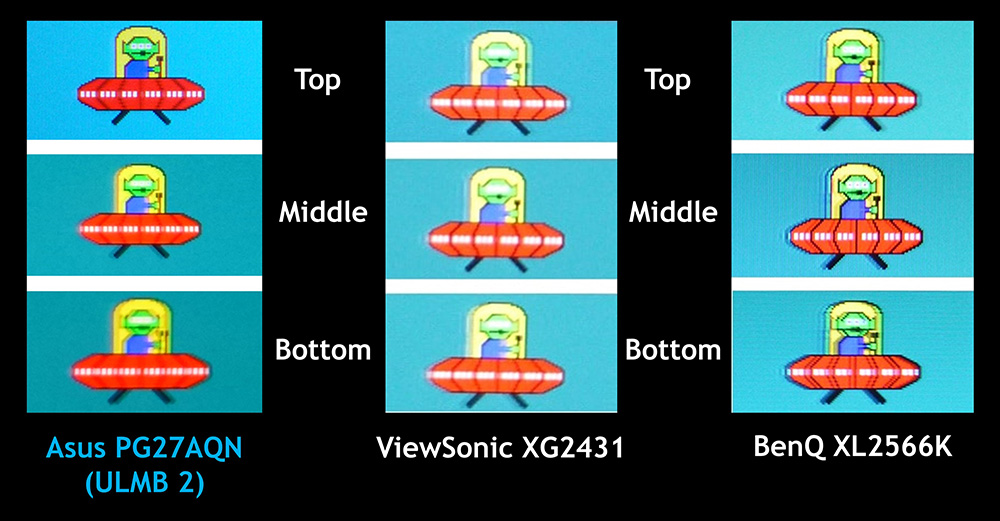
Thanks to one of the new Pulsar innovations – the rolling scan backlight, the motion clarity is as good at the top and bottom of the screen as it is in the middle:
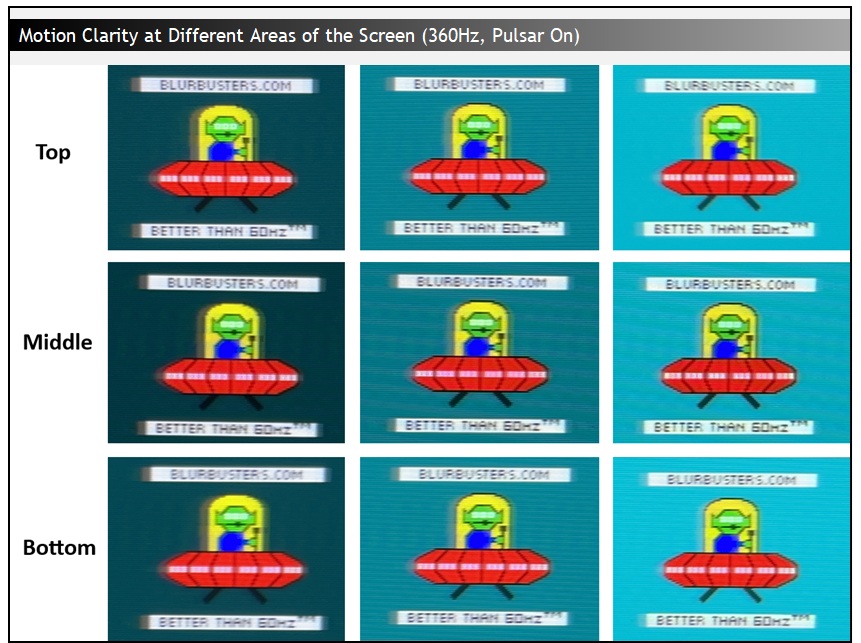
You get excellent motion clarity across the whole screen which is a great update compared with the vast majority of strobing blur reduction backlights we’ve tested in the past. You can learn more about how the rolling scan backlight works and why this makes such a difference in our G-sync Pulsar article here. Overall we were super-impressed with the performance of G-sync Pulsar when it comes to motion clarity and gaming experience.
G-sync Pulsar vs. OLED vs. 1000Hz LCD’s
You’re probably wondering how G-sync Pulsar compares to the highest refresh rate OLED monitors, that are now available up to 720Hz in some cases. Or how it might compare to the upcoming 1000Hz+ gaming LCD’s that have been announced. We’ve provided some commentary and comparisons in our Pulsar article here which covers that in a lot more detail, so we won’t repeat it all here in this review. Check that out for loads more info.
G-sync Pulsar Specs and Brightness
| Motion Blur Reduction Mode | ||
| Motion Blur Reduction Backlight | | |
| Refresh rates supported | 76 – 360Hz in VRR | |
| 60Hz support | | |
| Strobe length control | | |
| Strobe timing control | | |
| Available in SDR mode | | |
| Available in HDR mode | | |
| Brightness capability (SDR, max refresh rate supported) | ||
| Independent brightness control available | | |
| Motion blur OFF – Max brightness | 44 – 454 nits | |
| Motion blur ON – brightness range | 111 – 454 nits | |
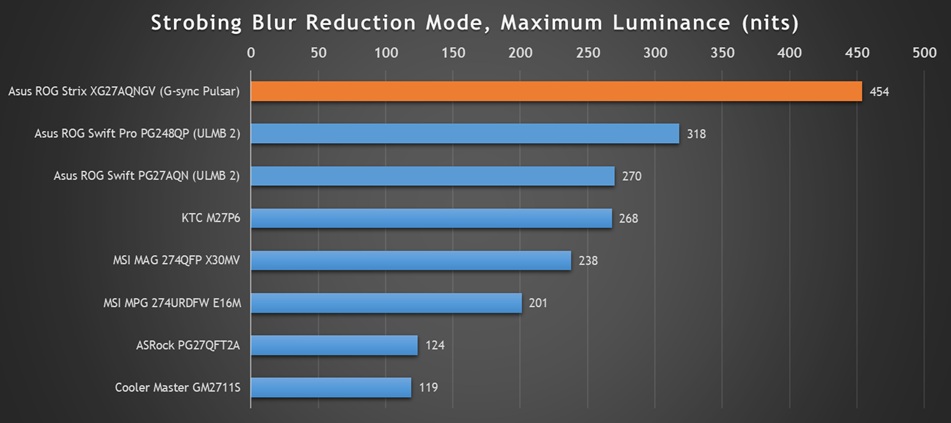
The screen can also get really bright with Pulsar on, actually reaching the same maximum luminance in our measurements as the off mode if you want. This gives you a very impressive brightness range to use, even for brighter room conditions and it can reach far brighter than any other strobing blur reduction mode we’ve tested in the past, exceeding the ULMB 2 screens and the Mini LED monitors we’ve tested as well:
The brightness control is available during Pulsar operation as well, and remembered independently between the off/on states which is great news. Again this makes it super-easy to enable Pulsar when you want to for gaming.
By the way, we’d recommend only enabling Pulsar for dynamic content, mostly for gaming where high frame rates are supported. You’d want to disable Pulsar for general desktop and office applications, there’s very little benefit there and it will just lead to potential flickering and eye strain problems.
ULMB 2 operation
ULMB 2 Operation
| Motion Blur Reduction Mode | ||
| Motion Blur Reduction Backlight | | |
| Refresh rates supported | 360, 240Hz only (120 and 60Hz from new firmware) | |
| 60Hz single strobe operation | | |
| Strobe length / Pulse width control | | |
| Strobe timing control | Not required | |
| Available in SDR mode | | |
| Available in HDR mode | | |
| Brightness capability (SDR, max refresh rate supported) | ||
| Independent brightness control available | | |
| Motion blur OFF – Max brightness | 44 – 454 nits | |
| Motion blur ON – brightness range | 111 – 454 nits | |
If you disable G-sync from the NVIDIA control panel, or are using a non-NVIDIA GPU then you have access to the ULMB 2 feature at various fixed refresh rates. It was originally available at 360Hz and 240Hz when we started our testing, but NVIDIA later released the firmware update which added support for 120Hz and 60Hz strobing which is great to see. The 60Hz mode is being added for enthusiasts but will exhibit more noticeable flicker at such a low frequency so use at your own risk.
Pulse width control
For ULMB 2 operation they’ve also added a strobe length control (via the ‘pulse width’ setting) although apparently it may not be introduced on all of the 4 initial Pulsar screens (confirmed present on Asus and Acer models). This isn’t available when using Pulsar, and we’re not sure if it would be practical to add a control for this as the pulse width and height is controlled dynamically during VRR situations to avoid brightness variation, and to account for the different frequency of the strobing. Those who like to adjust things for blur reduction modes will be pleased with the addition though for static ULMB 2 usage.
The Pulse width setting changes the “on” portion of the strobe which in some situations can help improve perceived motion clarity further, especially at lower ULMB refresh rates. However, the trade off is that when you lower the pulse width, the brightness of the screen is also impacted. You still have access to the normal brightness control so it’s likely you’ll be able to find a nice balance to get the screen to your desired brightness.
| 360Hz | Pulse Width setting | ||
| 100 | 50 | 10 | |
| Max luminance (nits) | 454 | 246 | 51 |
We measured the maximum luminance at 360Hz with the brightness control turned up to max (setting of 500) and at different pulse width settings to give you an idea. At 360Hz though we didn’t feel that the change really made any noticeable difference to perceived motion clarity. Still, if you’re going to reduce brightness, shortening the pulse width is probably the better way to do it.
ULMB 2 performance
When using ULMB 2 obviously you lose VRR support, but depending on how you configure the pulse width setting you can reach the same brightness range as Pulsar mode, and the motion clarity looks the same as it does during VRR at those same refresh rates. By adjusting the pulse width you can improve motion clarity a little further as well in ULMB 2 mode.
Obviously you need to be more mindful of your achieved frame rates in the games you play, and may need to set frame caps etc like you would with other normal fixed refresh rate-only blur reduction modes.
ULMB 2 at 60Hz
Where we did feel that the pulse width setting made a much more noticeable difference to motion clarity was at lower refresh rates. This 60Hz mode was added in the newly released v1.1.4 firmware as we discussed earlier. When you enable this mode the flicker is really obvious on Windows desktop and static images, but it’s less noticeable in dynamic content thankfully. The higher your overall brightness, the more obvious the flicker is as well, since the difference between the on and off states becomes more apparent.
Some people may find the flicker too noticeable and it could cause headaches or eye strain, but some people may like it for the impressive motion clarity improvements it offers.
| 60Hz | Pulse Width setting | ||
| 100 | 50 | 10 | |
| Max luminance (nits) | 454 | 245 | 50 |
You can get the same brightness levels at 60Hz as at 360Hz when using this mode and adjusting the pulse width setting. But changing the pulse width is the better way to lower your overall brightness at these lower refresh rates, as it also directly impacts motion clarity in a very noticeable way. As we said, the lower the brightness ends up being, the less the flicker becomes as well. Strobe behaviour for 60Hz mode is examined more in our G-sync Pulsar article if you want to delve deeper in to that.
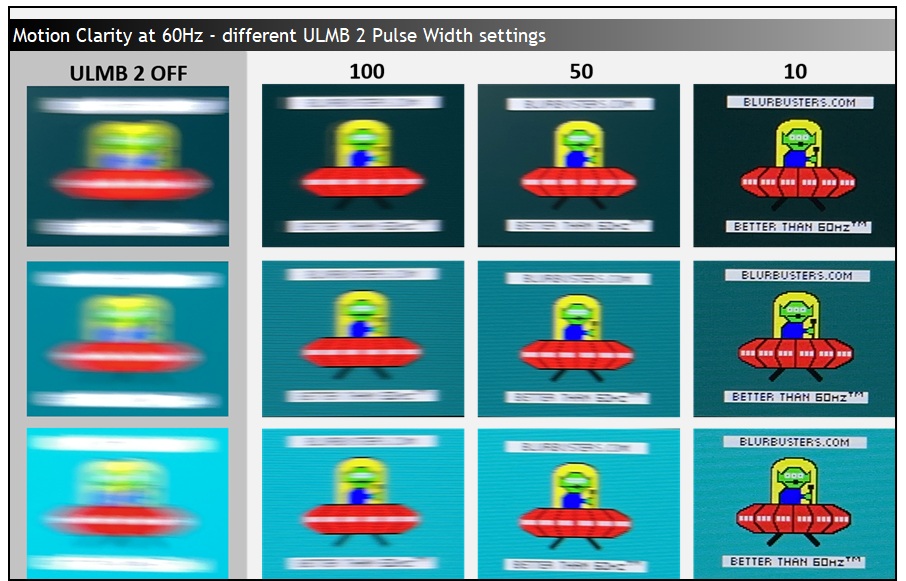
With a reduced Pulse Width setting the 60Hz ULMB 2 motion clarity can even look a bit better than the 360Hz mode which is amazing. The minor crosstalk you see at higher refresh rates disappears here, which is common for lower refresh rate strobing. There’s also more time for the G2G pixel transitions to be hidden during the “off” part of the strobe which improves sharpness further.
Obviously there’s a brightness trade-off as you reduce the pulse width, and the minimum 10 setting is probably going to be too dark for most gamers as it only reaches ~50 nits maximum. Below about 35 is where the motion clarity really starts to look amazing at 60Hz, but you’ll need to find a level that offers an appropriate brightness for your usage.
So overall you can get a really impressive motion clarity potential using this mode, as long as you don’t find the flicker problematic. Keep in mind of course that at lower refresh rates other factors like end to end system latency, the stroboscopic effect and frame rate support come in to play when comparing it to 360Hz. It’s not only about motion clarity. We’re sure enthusiasts will love this newly added mode though.
Console Gaming
The screen offers a native 1440p resolution but includes “Virtual 4K” support, allowing you to input a 4K resolution source if you want, including setting the console to a maximum 4K @ 120Hz.
| Console Gaming | |
| Native panel resolution | 2560 x 1440 (1440p) |
| Maximum resolution and refresh rate supported | 4K @ 120Hz |
| Virtual 4K support | |
| 4K at 24Hz support | |
| 4K at 50Hz support | |
| HDMI connection version | 2.1 |
| HDMI connection bandwidth | 40 Gbps |
| HDMI-CEC auto switch | |
| VRR support | |
| Auto Low Latency Mode (ALLM) | |
| HDR10 support | |
| Dolby Vision HDR support | |
| Motion blur reduction mode (at 120Hz and 60Hz) | |
| Integrated speakers | |
| Headphone connection | |
| Ultra high speed HDMI 2.1 cable provided | |
There’s support for VRR and (after the new firmware) you can also use the blur reduction mode with the console set at 120Hz or even 60Hz if you want which can help improve motion clarity and sharpness pretty well. There’s a headphone connection but no integrated speakers on this model keep in mind. We also found that there was no support for 4K 24Hz or 4K 50Hz content which could restrict some movie playback smoothness in some cases.
The screen has very limited HDR capabilities and so while it will support an HDR10 input signal, the performance is nothing like you could get from modern Mini LED or OLED monitors. This isn’t a screen for HDR gaming and you’d be better looking at an OLED panel if that’s a priority for you.
Lag
Read our detailed article about input lag and the various measurement techniques which are used to evaluate this aspect of a display. The screens tested are split into two measurements which are based on our overall display lag tests and half the average G2G response time, as measured by our oscilloscope. The response time element, part of the lag you can see, is split from the overall display lag and shown on the graph as the green bar. From there, the signal processing (red bar) can be provided as a good estimation of the lag you would feel from the display. We also classify each display as follows:
Lag Classification (updated)
- Class 1) Less than 4.17ms – the equivalent to 1 frame lag of a display at 240Hz refresh rate – should be fine for gamers, even at high levels
- Class 2) A lag of 4.17 – 8.33ms – the equivalent of one to two frames at a 240Hz refresh rate – moderate lag but should be fine for many gamers. Caution advised for serious gaming
- Class 3) A lag of more than 8.33ms – the equivalent of more than 2 frames at a refresh rate of 240Hz, or 1 frame at 120Hz – Some noticeable lag in daily usage, not suitable for high end gaming
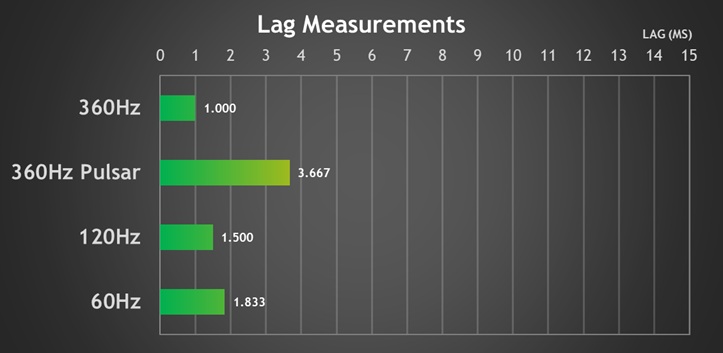
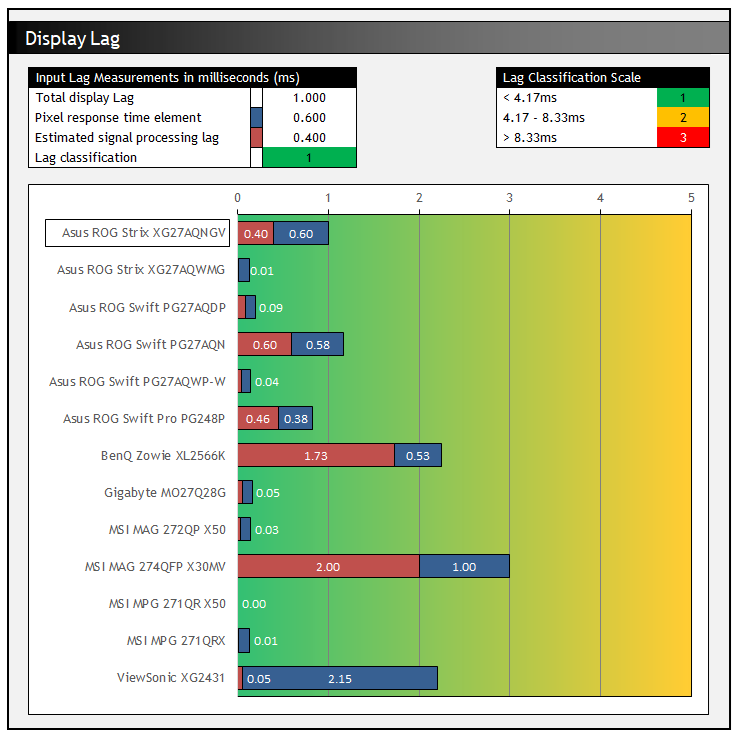
There is a very low lag on the XG27AQNGV measured at 1.0ms average at 360Hz and much of that will be made up from the pixel response times (~0.6ms), leaving us with ~0.4ms signal processing delay which is great. Perhaps we were expecting this to be slightly lower, but we’re arguing about <1ms here so it’s not really of any real consequence.
You can see that this lag doesn’t increase much at all for lower fixed refresh rates like 120Hz and 60Hz devices which is also great news for people using those refresh rates from external devices. There is a lag penalty of around 2.5 – 3.5ms or so when using Pulsar / ULMB according to our measurements, but it remains very low and shouldn’t be a problem for the vast majority of gamers.
Conclusion
The XG27AQNGV and its NVIDIA G-sync Pulsar capabilities were really impressive, and we’d consider this the new gold standard for strobing blur reduction technology. There was a huge amount of things to test and experiment with but we were really impressed by the performance of this new strobing blur reduction technology. It’s great to see it finally supported properly alongside VRR, offering excellent motion clarity at all refresh rates, including when fps drop low. It makes a massive difference to motion clarity in those situations. The user experience for Pulsar activation and configuration was also great, as were things like the firmware update procedure which was very simple.
Motion clarity in fast moving content was excellent, even for lower refresh rates and even for the newly added 60Hz ULMB mode. The rolling scan backlight made a big difference to overall screen clarity and eliminated strobe cross talk very well, and the addition of a new pulse width control for fixed-refresh rate ULMB 2 mode was very welcome, and made tweaking motion performance and brightness more versatile. It also offers an excellent brightness range which is great to see.
One drawback of these new Pulsar screens is that you can only enjoy them fully if you’ve got an NVIDIA GPU at the moment, with Pulsar mode being unavailable to AMD and other GPU users. You can still use normal VRR and you can still used fixed refresh rate ULMB 2, but you just can’t combine them for the Pulsar experience unfortunately. We’d like to see that opened up in the future if at all possible.
Away from Pulsar / strobing modes, the response times were excellent for an IPS panel, with proper variable overdrive used for a simple experience and great performance during VRR situations. Input lag was super-low, there’s a wide range of gaming extras and settings, but console support had a few minor gaps in support for things like 4K 24Hz / 50Hz movie playback (may not be an issue to most people though).
The IPS panel provided the usual solid all round performance with a good picture quality, wide viewing angles and good colours. Factory calibration was very strong, and the sRGB emulation mode was very flexible and well configured. You have the typical low contrast ratio of an IPS panel, and the off-angle IPS glow that are inherent problems with this panel technology though compared with VA and OLED panels. HDR support is also pretty much non-existent, so there’s definitely a gap there for HDR gaming. We’d love to see Pulsar technology developed for Mini LED monitors and OLED in the future to plug that gap. Although it’s firmly a gaming screen, some people may miss some of the modern connections and extra features you get on many top-end gaming monitors nowadays, although this has presumably been done to keep the price to a more modest level.
The XG27AQNGV is available to buy now in many regions, and at the time of writing retails for $650 USD or £629 GBP (affiliate links). You can check latest pricing and availability for your region using our link above too.

| Pros | Cons |
| G-sync Pulsar works extremely well and provides excellent gaming experience | Typical low contrast ratio from the IPS LCD panel compared with other panel technologies |
| Newly added ULMB 60Hz mode and Pulse Width control are great for enthusiasts | G-sync Pulsar usage locked to NVIDIA GPU’s only |
| Excellent pixel response times, variable overdrive and low lag combine for a great gaming experience | Some minor gaps in console support |
We may earn a commission if you purchase from our affiliate links in this article- TFTCentral is a participant in the Amazon Services LLC Associates Programme, an affiliate advertising programme designed to provide a means for sites to earn advertising fees by advertising and linking to Amazon.com, Amazon.co.uk, Amazon.de, Amazon.ca and other Amazon stores worldwide. We also participate in a similar scheme for Overclockers.co.uk, Newegg, Bestbuy , B&H and some manufacturers.