
[Round-up] Asus Unveil Next Gen Monitors at CES 2026
Disclaimer: this article includes sponsored coverage from CES 2026, but all content, opinions and commentary are our own as always
Introduction
We take a look back at what was showcased by Asus at this years CES event in Las Vegas, including the latest OLED gaming displays featuring the latest generation of QD-OLED and WOLED technologies, a 5K dual-mode display and their new G-Sync Pulsar Monitor as well. Plus we take a sneak peak at some of their latest ProArt monitors too for good measure.
Asus CES 2026 Event Video Coverage
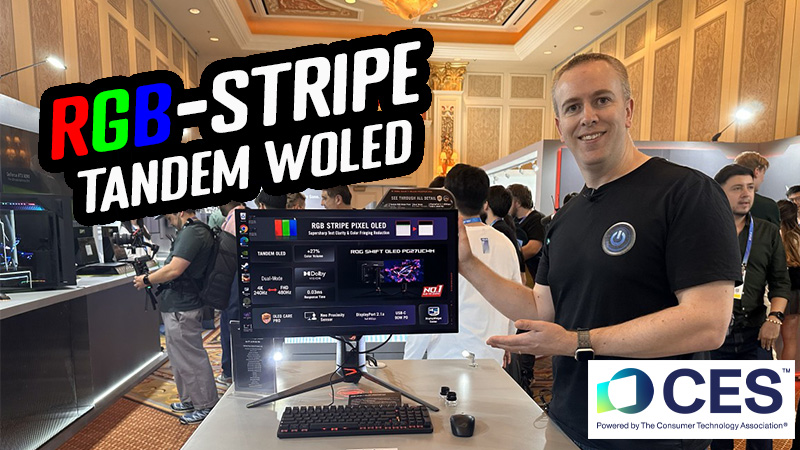
The World’s first RGB-stripe Tandem WOLED monitor
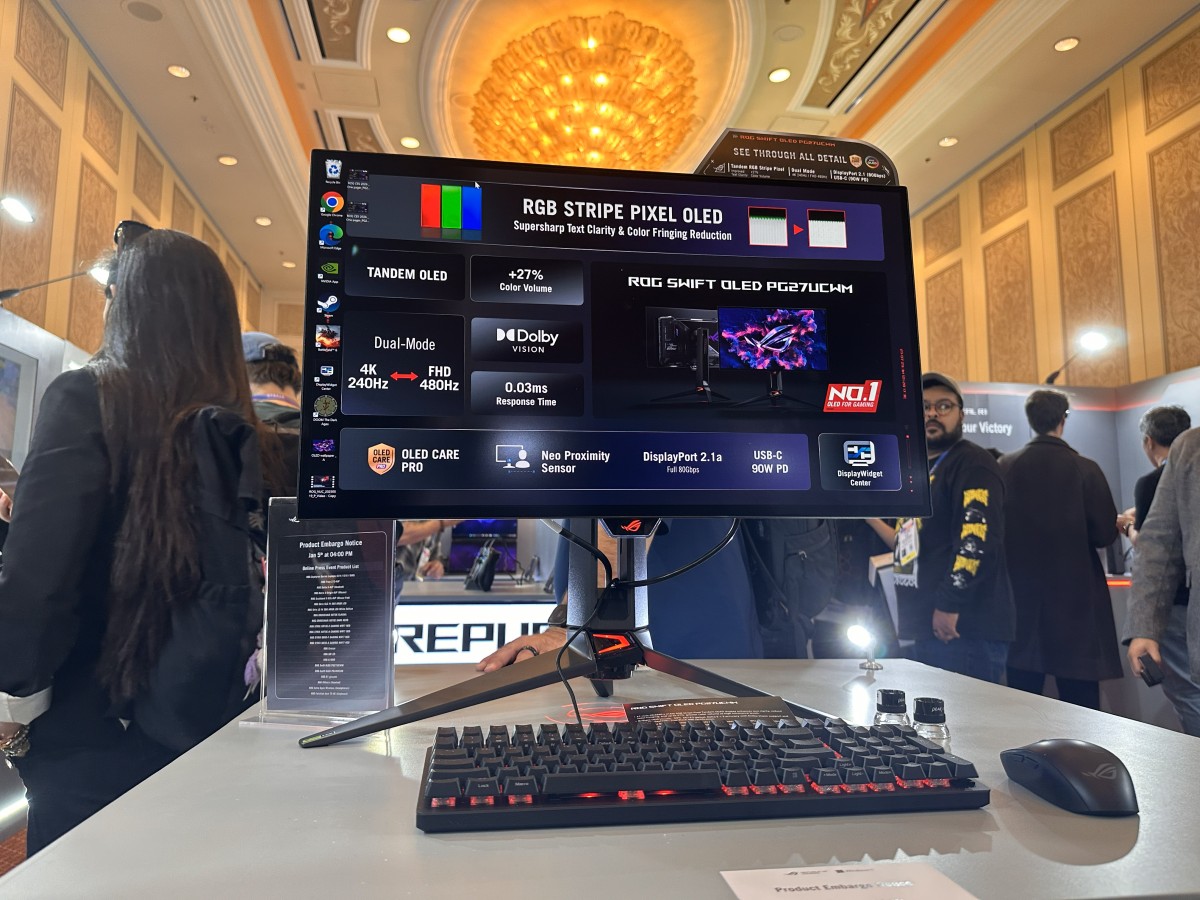
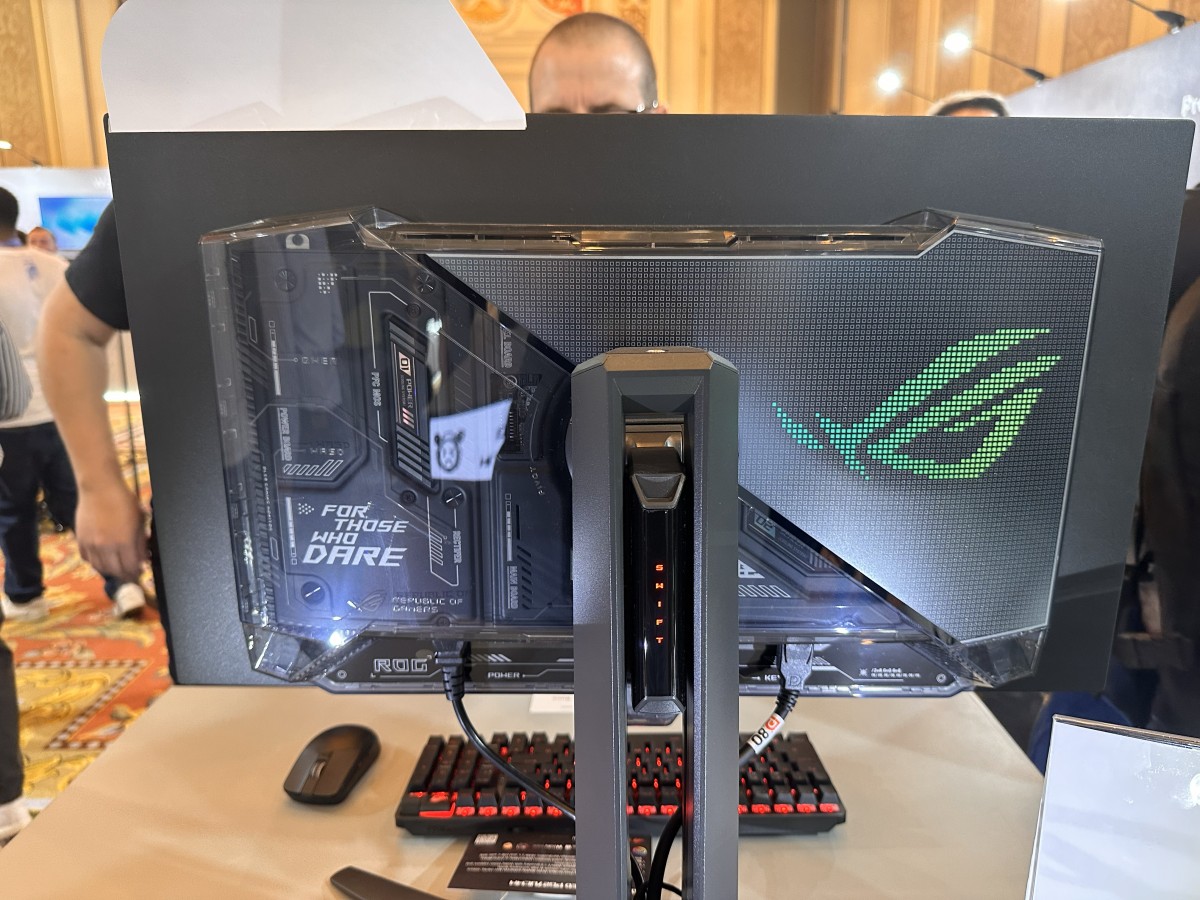
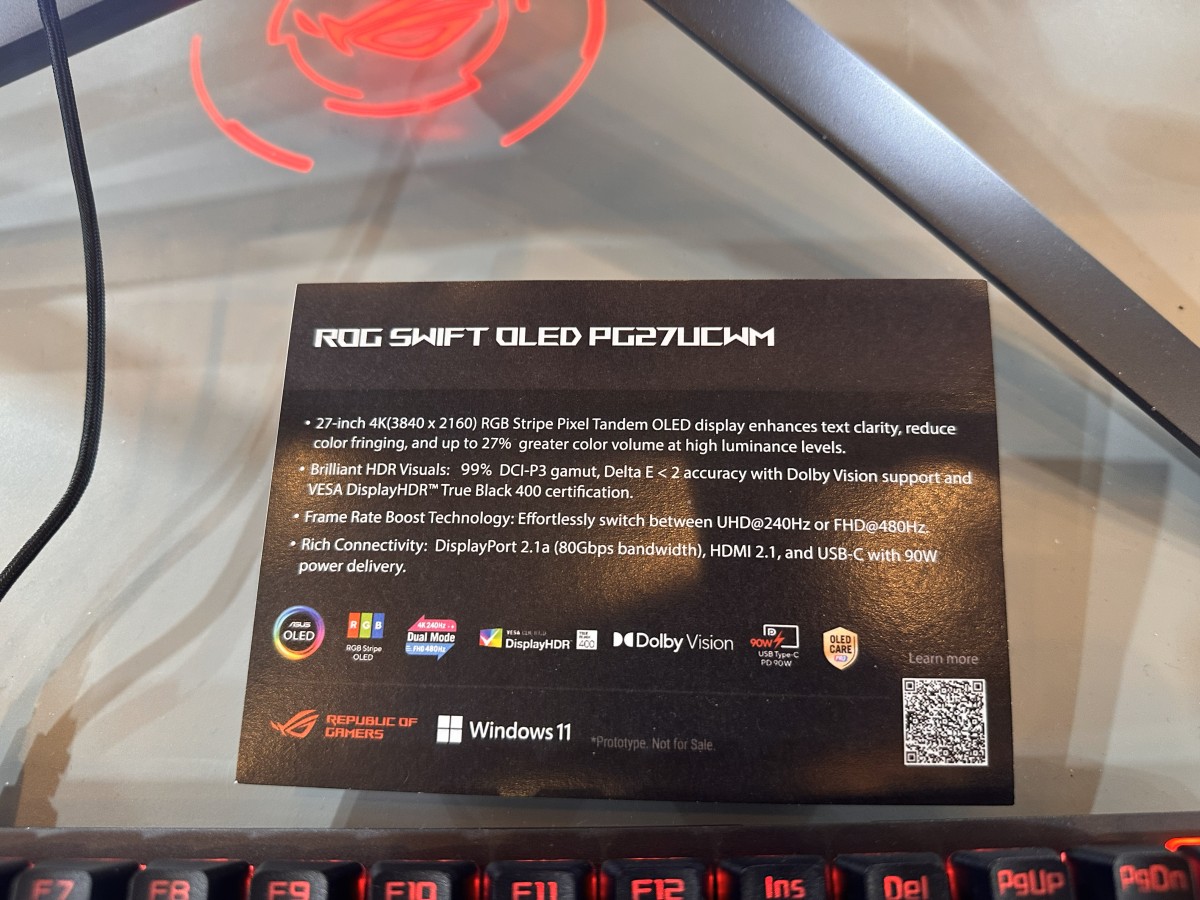
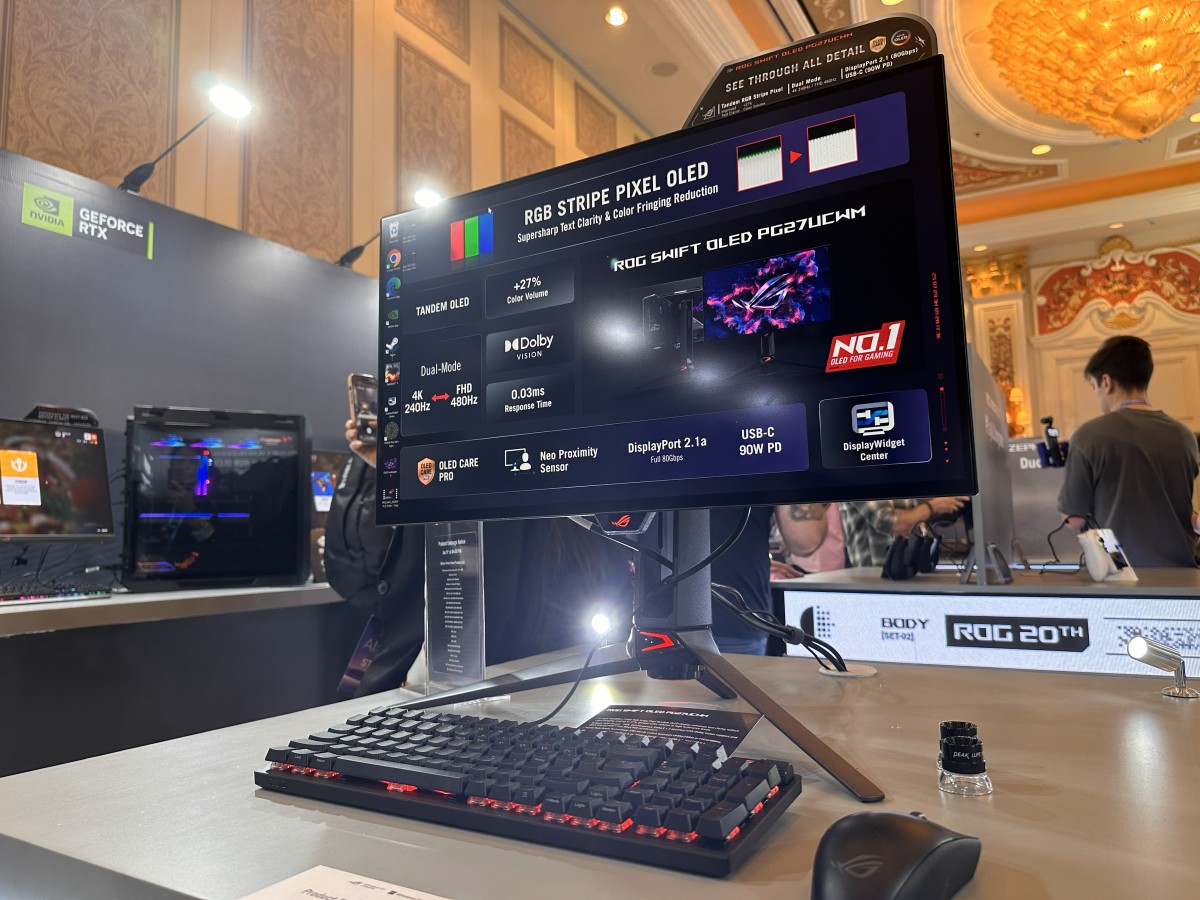
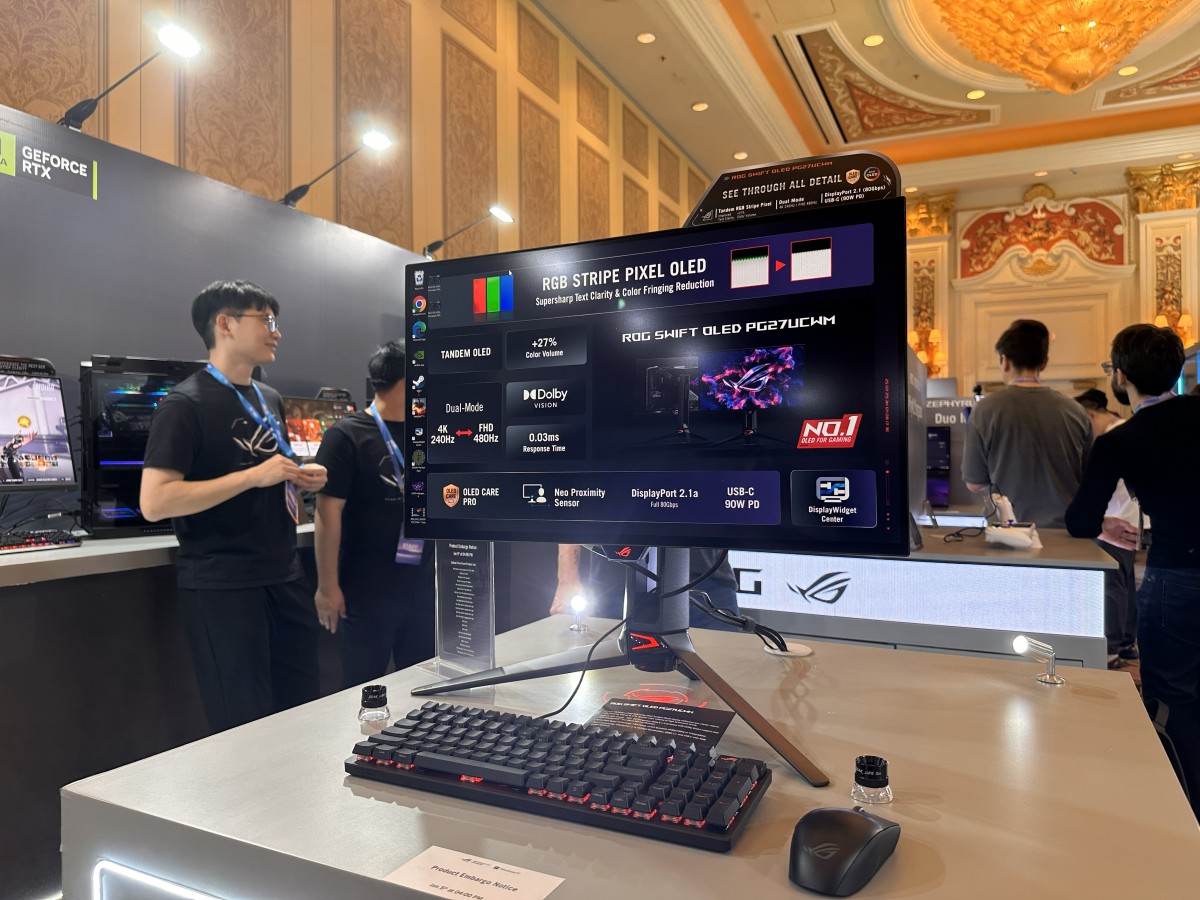
The biggest news came by way of an exciting new OLED monitor they had on display. The ROG Swift PG27UCWM is a new 27″ sized screen built around a brand new 4th Gen Tandem WOLED panel from LG.Display, which offers a 3840 x 2160 “4K” resolution for the first time from this panel technology in this size, along with an RGB-stripe sub-pixel layout (which is again a first). It’s got an attractive new design as well, similar to the PG27AQWP-W we saw last year, but this time in a black design instead of silver.
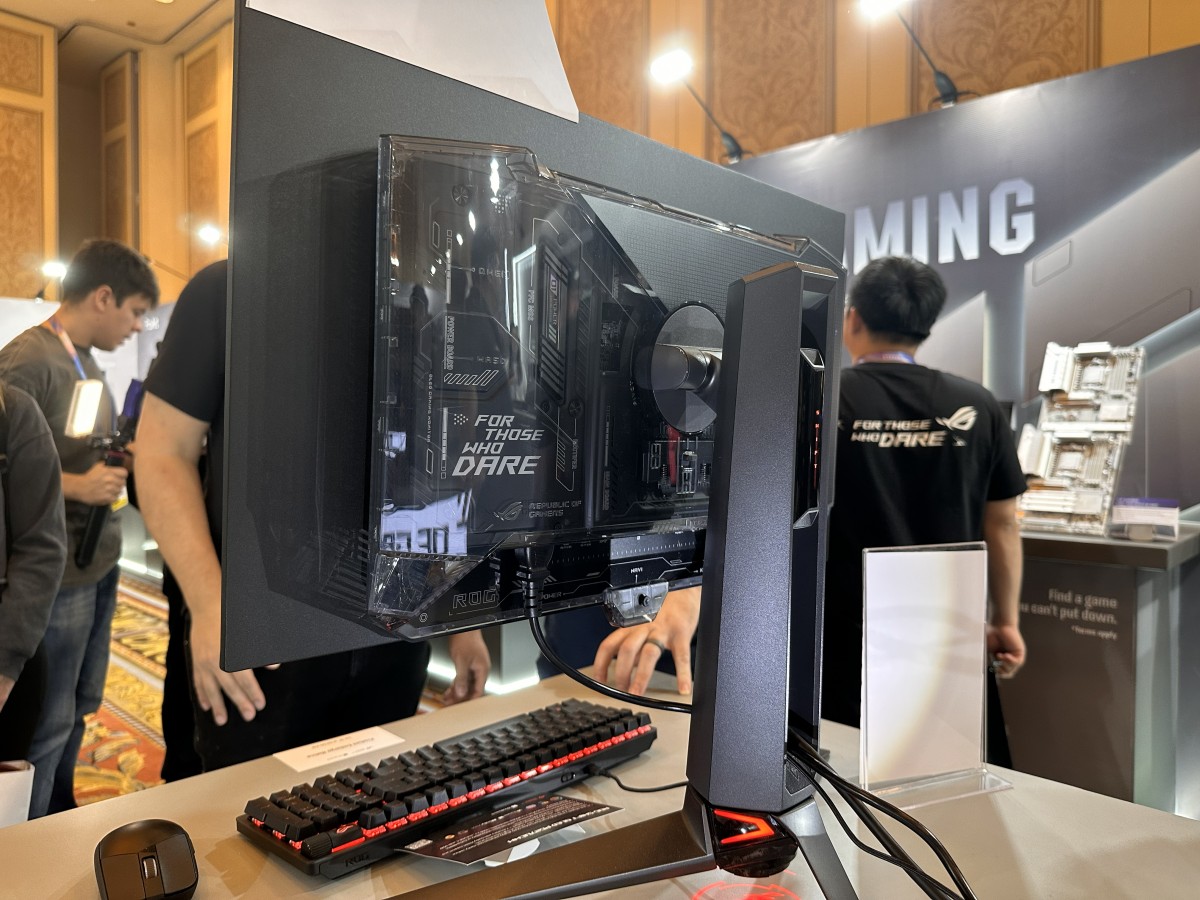
True RGB-stripe sub-pixel layout
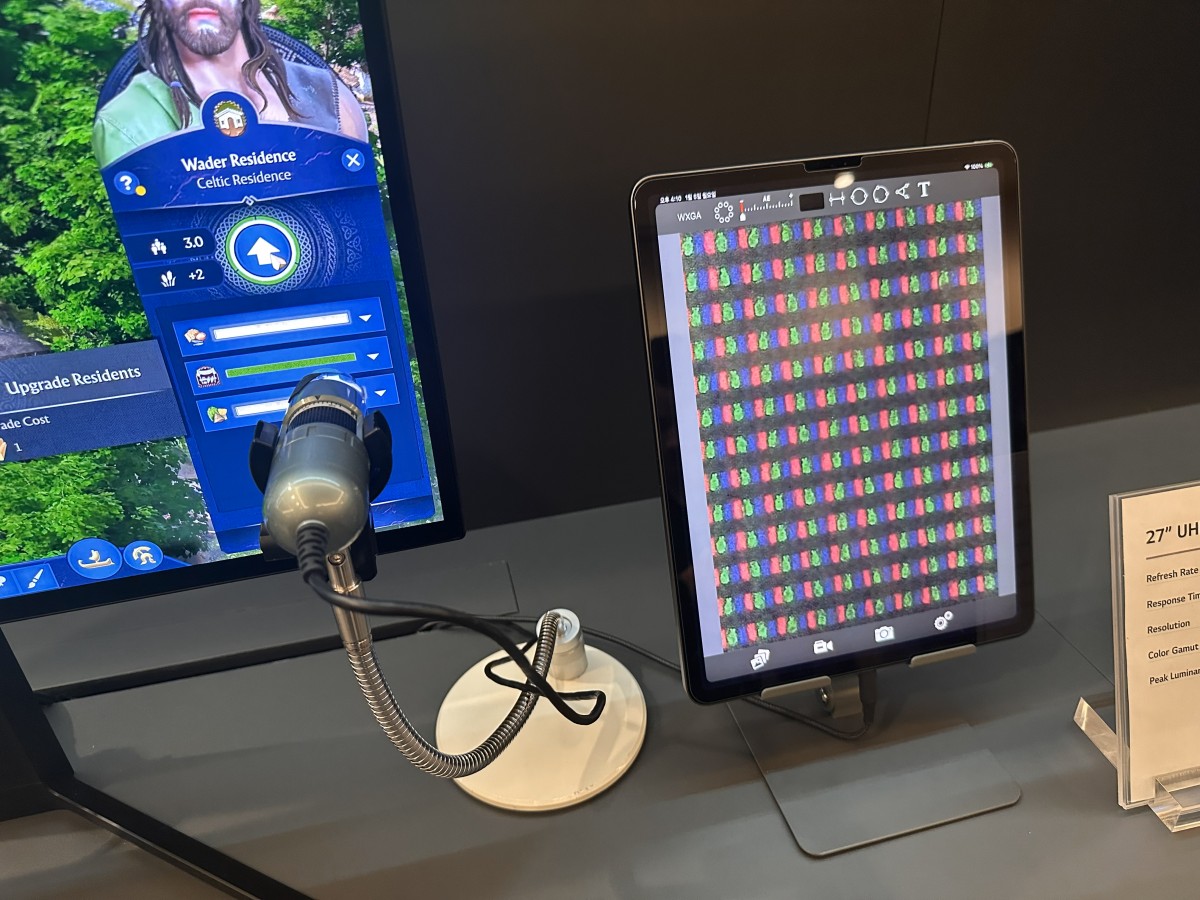
This new RGB stripe layout will improve the text and image clarity compared with earlier WOLED panels which featured an additional white sub-pixel, which could lead to some text fringing and artefacts, putting off some people from moving from their trusty LCD monitors to an OLED. The new panel does away with the white sub-pixel and returns to a standard RGB layout which Windows recognises properly, and which therefore eliminates those problems. When combined with a high ~166 PPI pixel density like on this 27″ panel, this should offer amazing sharpness. LG Display announced the production of this new WOLED panel on the lead up to CES, and Asus are the first manufacturer to adopt it in to a display.
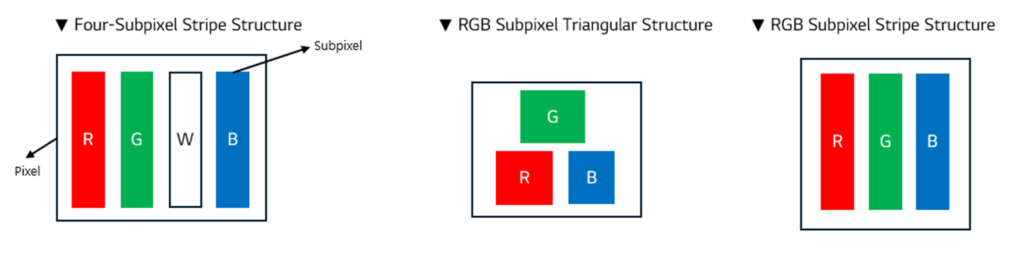
Will there be other RGB-stripe WOLED panels?
This is the first and so far only WOLED panel to feature this new RGB-stripe layout, all the other new WOLED monitors being showcased will feature their previous RGWB layout, with the added white sub-pixel. We’re told by LG Display that they will be exploring RGB stripe options in other sizes in the future as well, although they’re focusing on development and mass production of this 27″ 4K panel at the moment.
TrueBlack glossy coating
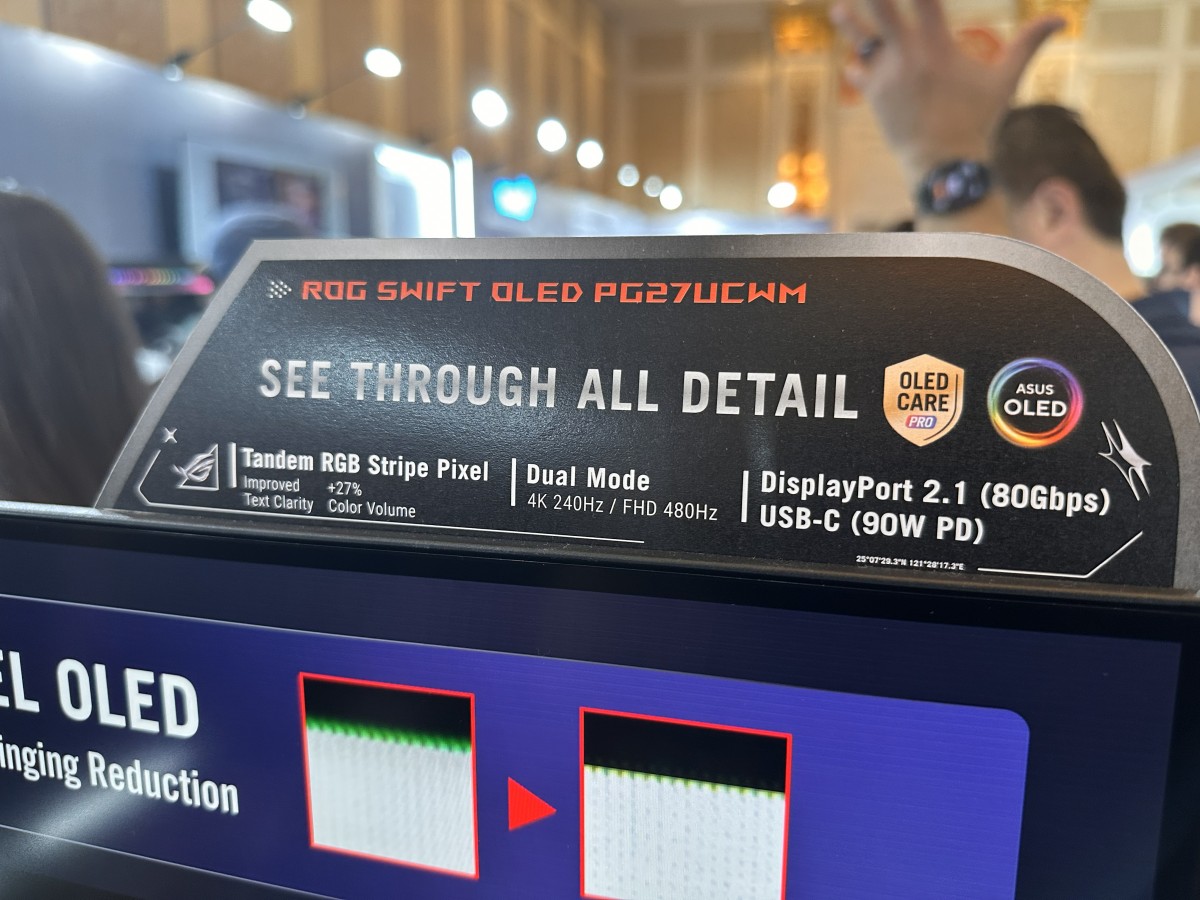
Although the prototype sample at CES featured a matte AG coating, Asus told us that this screen will feature their ‘TrueBlack’ Glossy coating when it is launched later in the year, which will enhance the image quality on the already improved panel for a super clear and sharp image. That could be a killer combination for many people.
Other specs and features
The screen offers a native 240Hz refresh rate which can be doubled to 480Hz when dropping to a lower 1080p resolution using a dual-mode function. That will be supported by adaptive-sync for VRR from compatible systems. In other specs this 26.5″ (27″ class) sized screen with a flat format offers a 3840 x 2160 “4K” resolution, 0.03ms G2G response time spec, 10-bit colour depth and a wide colour gamut covering 99% of the DCI-P3 colour space. It also offers a factory calibrated Delta E>2 accuracy too. DisplayPort 2.1 (UHBR20), HDMI 2.1 and USB type-C (90W) connections will be featured.
Brightness capabilities are still under review
Asus tell us that they are still defining the brightness capabilities and working with LG Display to optimize the panel. LG Display have told us that the panel spec is expected to offer 250 nits brightness for SDR, along with 1000 nits peak brightness (1.5% APL) for HDR, 500 nits at 10% APL and 250 nits at 100% APL. That would mean it would be certified under the VESA DisplayHDR 400 True Black tier, although Asus suggested to us at CES that they were aiming for 300 nits SDR / full screen HDR brightness which would then allow DisplayHDR 500 True Black certification.
Consider the brightness specs as TBC, but it will have somewhat of a drop compared with other modern Tandem WOLED panels since they’ve now removed the white sub-pixel, which was used to boost brightness. Asus have confirmed the screen will support Dolby Vision HDR content alongside HDR10.
Clarification around the “WOLED” naming convention
Some people have asked us about this already – if the white sub-pixel has now been removed, does that mean this is no longer “WOLED” (White OLED)? Actually it IS still considered a Tandem WOLED panel, as the “W” does not represent the white sub-pixel at all, rather it represents the colour of light which is produced by the OLED stack. This is one of those long-standing misconceptions we believe in the market, and it hasn’t really mattered at all until now anyway as their WOLED panels have always had that white sub-pixel.
In the Tandem stacking method for monitor panels, they produce white light, as compared with something like QD-OLED which produces blue light. In both cases the light produced is passed through relevant colour filters for red, green and blue. It is this production of white light that leads to the “W” in WOLED in this context.
Availability and pricing
We are told this display should start appearing in Q2 2026, although some media outlets were also told H2. We’ll see how development goes and expect to see more of it at Computex in May. Pricing is still being finalised but we were told it should retail for around the same price as the ROG Swift PG27UCDM model.
Game-changing ultrawide 5th Gen QD-OLED monitors unveiled
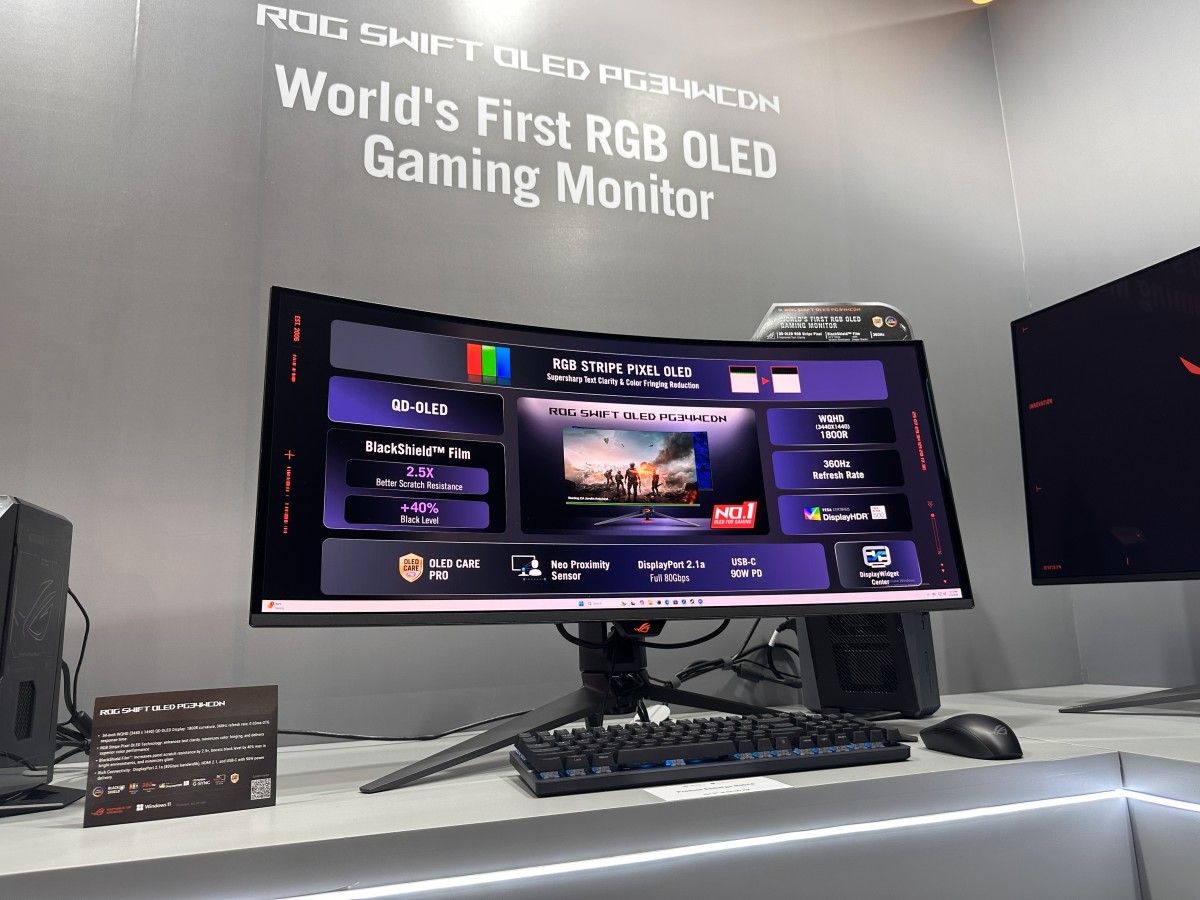
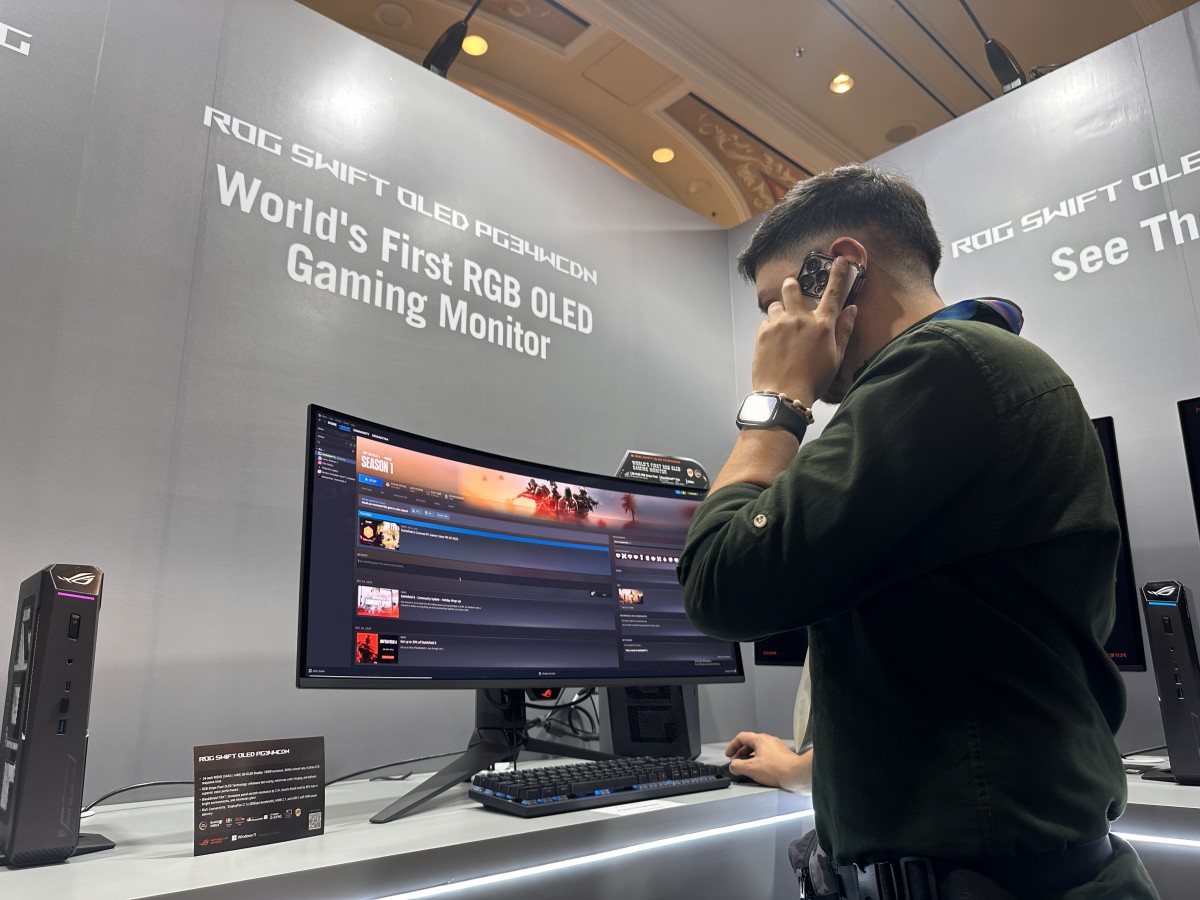
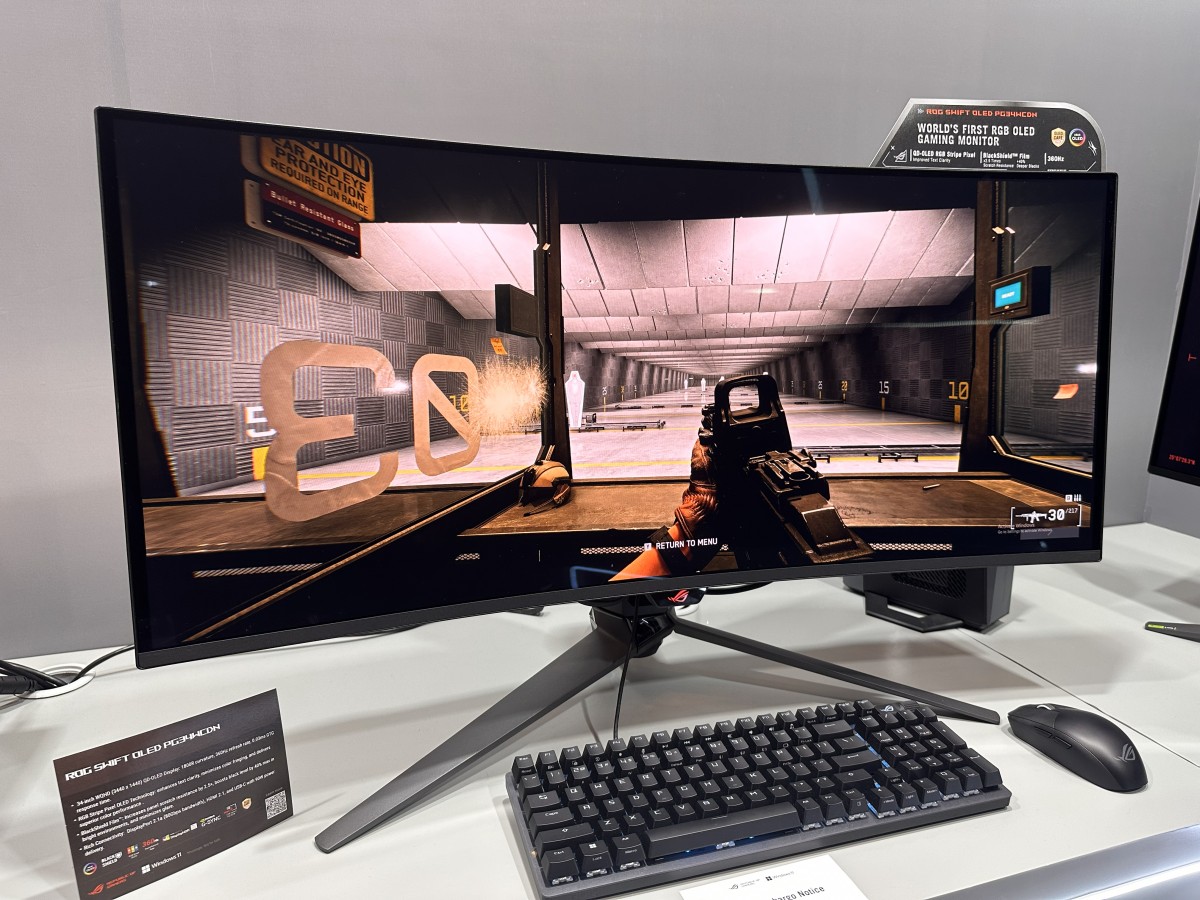
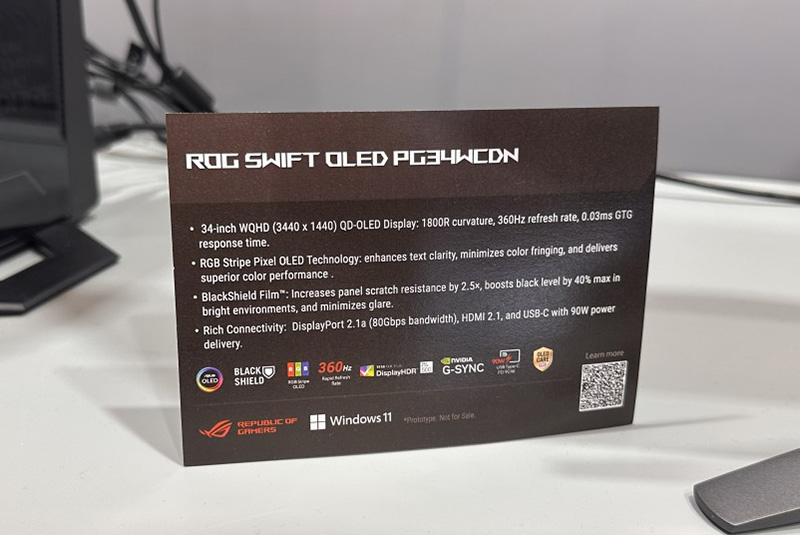
Also showcased at CES was the ROG Swift OLED PG34WCDN which saw the introduction of Samsung Display’s brand-new 5th-Gen QD-OLED panel technology. This 34” ultrawide panel with a 1800R curvature features a 3440 x 1440 resolution and 360Hz refresh rate. We’ve actually had chance to review this screen in full ahead of the event, so if you want to know loads more about it, check that out here.
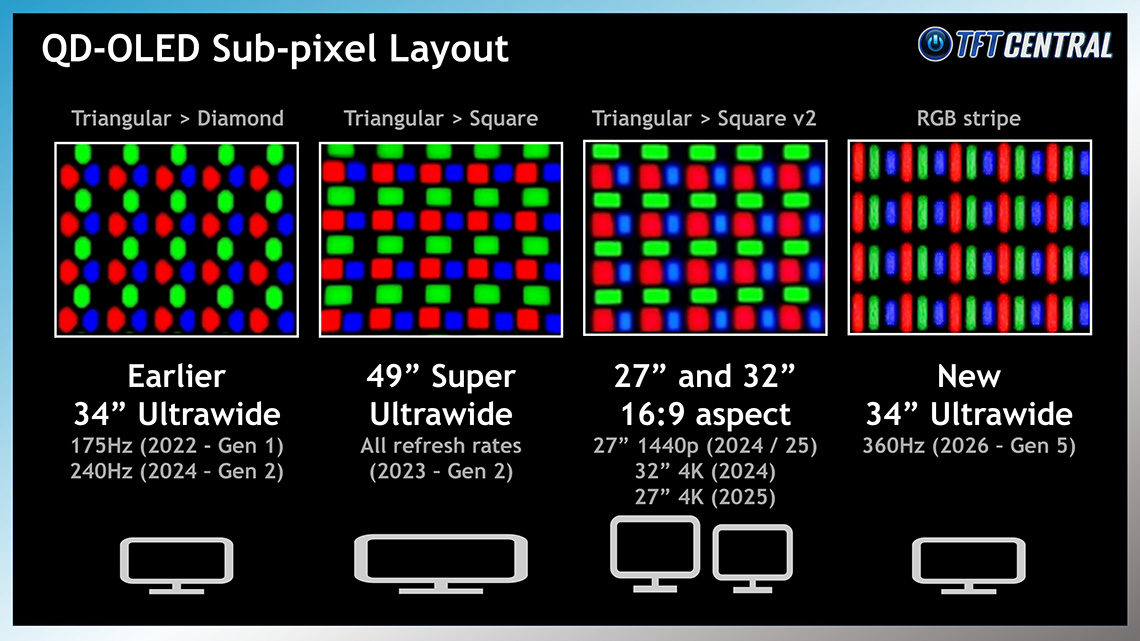
RGB-stripe layout arrives on QD-OLED
We were excited to see this new panel technology being utilised in Asus’s new monitor, which also offers for the first time on a QD-OLED panel, an RGB stripe pixel arrangement. Like on the 27″ Tandem WOLED panel discussed above, this enhances the image and text clarity, even more so on a lower pixel density screen like this.
BlackShield Film
As well as the updated pixel layout, this new QD-OLED panel features a new film, and optimized panel structure from Samsung Display, which Asus are marketing under the brand of ‘BlackShield Film’. This is designed to deliver deeper and more accurate blacks in the presence of ambient lighting, and eliminate the purple tinting you see on earlier QD-OLED panels.
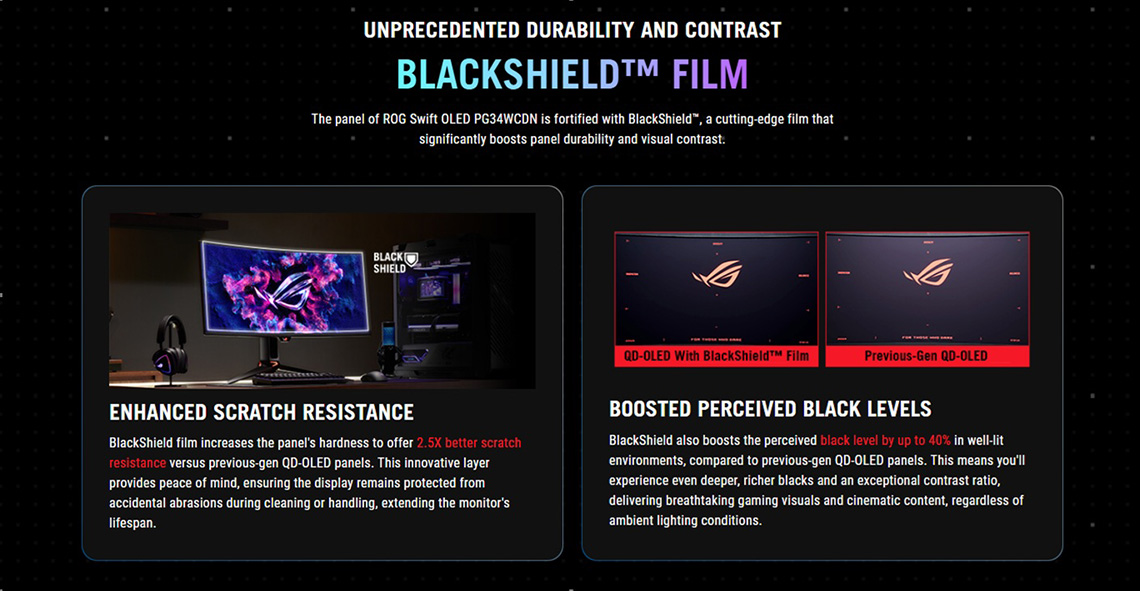
Furthermore, the inclusion of a ‘BlackShield Film’ “increases panel’s hardness for 2.5 times better scratch resistance and boosts the perceived black level by up to 40% (in well-lit environment)“.
Other specs and features
In other specs the 1800R curved QD-OLED panel offers a 3440 x 1440 resolution, 0.03ms response time spec, 1.5 million:1 contrast ratio, 300 nits brightness (SDR), 178/178 viewing angles, 10-bit colour depth and a wide colour gamut covering 99% of the DCI-P3 colour space. It also offers a factory calibrated Delta E<2 colour accuracy too.
The 360Hz refresh rate is supported by adaptive-sync for variable refresh rates from compatible systems. It has superior HDR capabilities compared with earlier QD-OLED monitors, with certification under the VESA DisplayHDR True Black 500 tier and offers for the first time a peak brightness spec of 1300 nits in HDR instead of the typical 1000 nits.
ELMB (Extreme Low Motion Blur) is also featured, for motion blur reduction using a BFI mode, and ROG Gaming AI technology is incorporated including AI Visual, Dynamic Shadow Boost and Dynamic Crosshair. Asus’s useful DisplayWidget Center software is also included which helps you control and customise your Asus monitor to meet your gaming needs.
A full range of OLED Care Pro features are included, along with their Neo Proximity Sensor to help mitigate the risk of image retention and burn-in. There are also extensive connectivity options including 2x HDMI 2.1, 1x DisplayPort 2.1 (UHBR20 – full 80 Gbps bandwidth) and 1x USB Type-C connection (with DP Alt Mode and 90W power delivery). There’s also 3x USB-A data ports and a headphone connection.
Pricing and availability
This screen is due for release in Q1 2026, but pricing is still TBC. We’ve had chance to get our hands on one of these at the end of last year for testing so if you want to know how this new screen measured up then please see our full review linked here.
The popular PG32UCDM monitor gets a makeover and upgrade
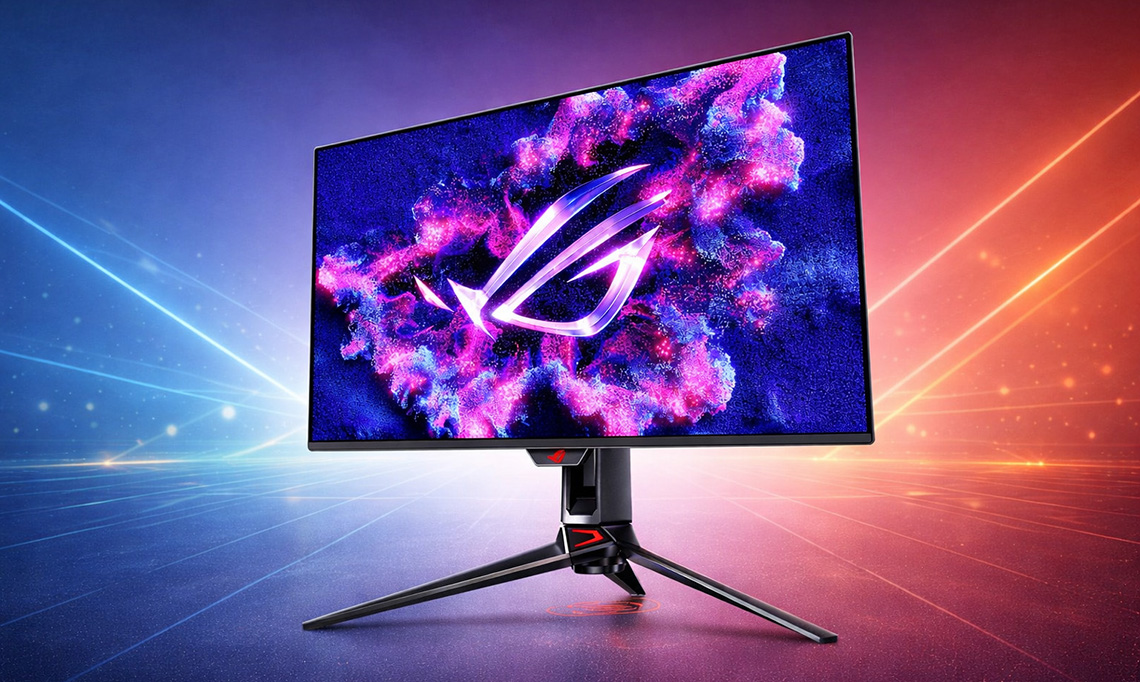
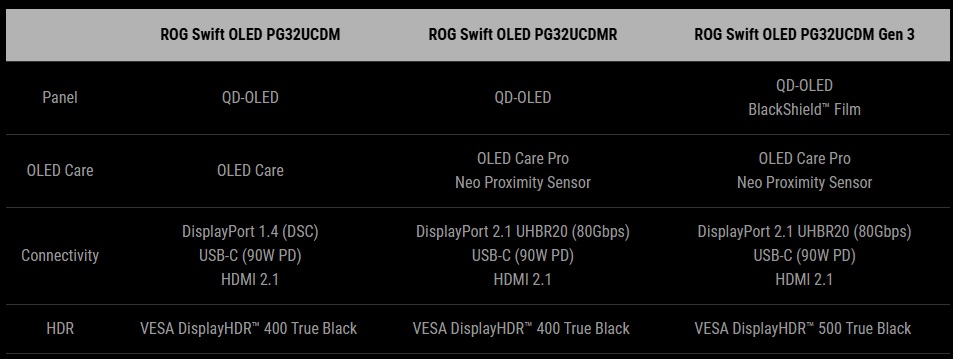
Also revealed at CES was the news that the super-popular PG32UCDM model has been through a further update and the Gen 3 version was on display at CES, now with a further range of updates and improvements. This goes by the name of the ROG Swift PG32UCDM3 now, and it was set up next to a previous model to help demonstrate some of the differences, most notably in relation to a shift to a 4th Gen QD-OLED panel from Samsung Display which promises to help improve both the panel brightness and its life-span.
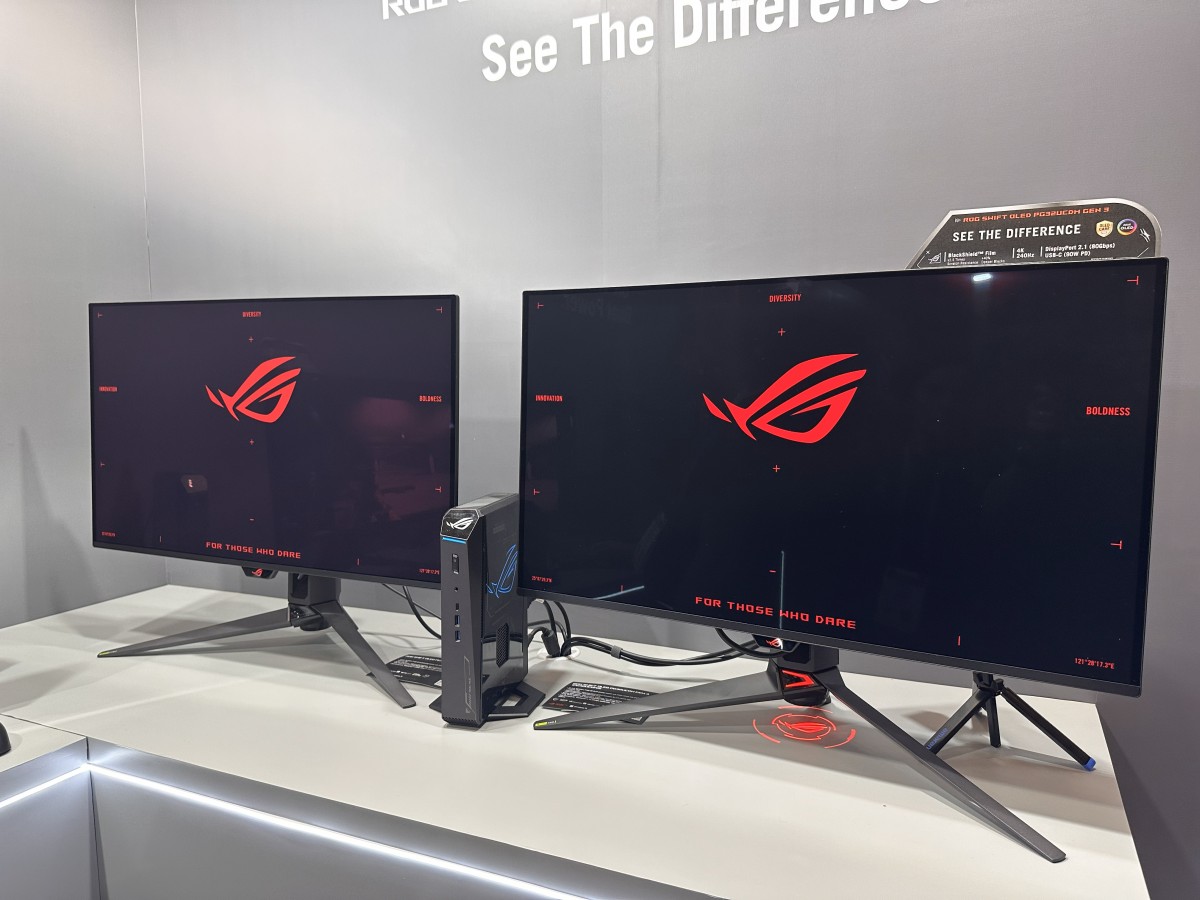
The panel also includes their new ‘BlackShield Film’ we’ve talked about above, which boosts the perceived black level by up to 40% in well lit rooms meaning deeper and richer blacks and the elimination of typical purple tinting. It is also designed to increase panel hardness from 2H to 3H and offer 2.5x better scratch resistance. You can see in these side by side comparisons at the event the difference the new BlackShield Film makes.
The ROG Swift PG32UCDM3 remains 31.5″ in size (32″ class) with a flat format, 3840 x 2160 “4K” resolution and 240Hz refresh rate, but as explained above the panel has been updated to a 4th Gen QD-OLED, featuring Samsung Display’s latest 3.0 OLED material. Other notable differences are a 300 nits SDR brightness (previously 250 nits) and VESA DisplayHDR 500 TrueBlack tier certification (previously TB400). Peak brightness spec remains at 1000 nits, and it still features the triangular sub-pixel layout as opposed to an RGB-stripe, although with a high pixel density (140 PPI) text clarity is still excellent.
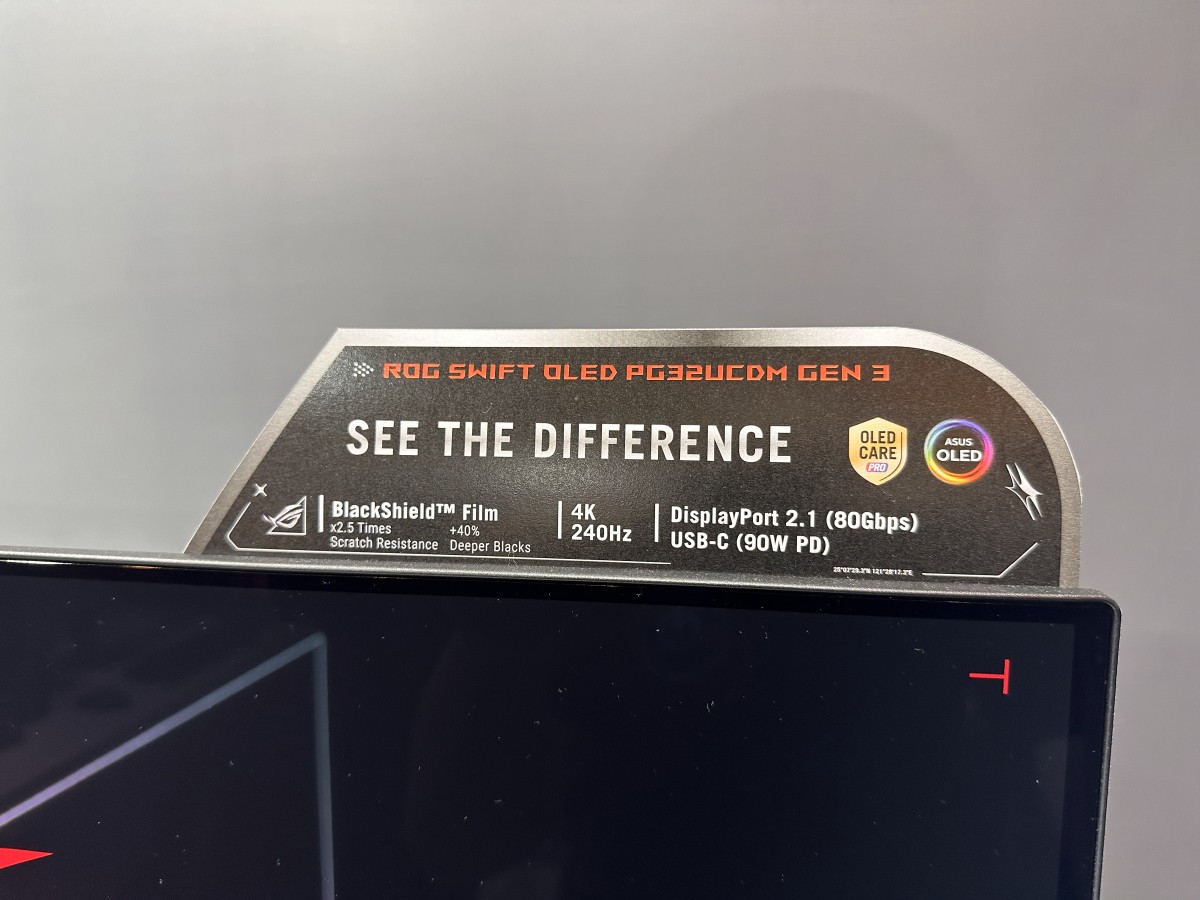
The screen’s safety features have also improved with a move to Asus’ ‘OLED Care Pro’ feature set and their new Neo Proximity Sensor that’s been added. Connectivity has also been enhanced as it now offers 1x DisplayPort 2.1 (UHBR 20, 80Gbps bandwidth) along with HDMI 2.1 and USB type-C. The latter of which has also had a power delivery upgrade.
Pricing and availability
Asus tell us that the PG32UCDM3 should be available towards the end of Q1, and on their product page they list it with a price of $1,299 USD. Further information: The Asus product page is available here
We’ve had chance to review this screen in full already, so if you want to know loads more about how it compares with the earlier PG32UCDM versions, and how the new panel and coating perform, check that out here to find out loads more.
NIVIDA G-sync Pulsar monitor is finally here!
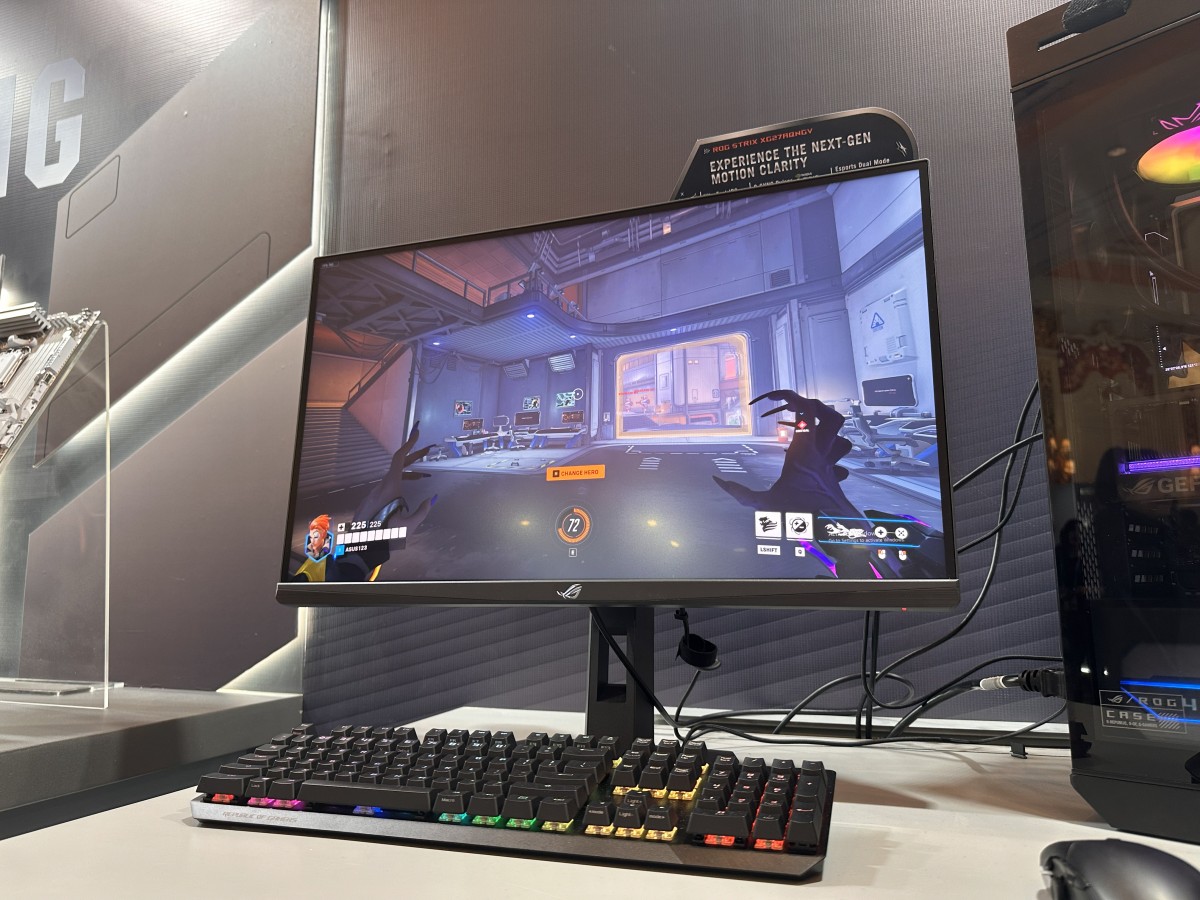
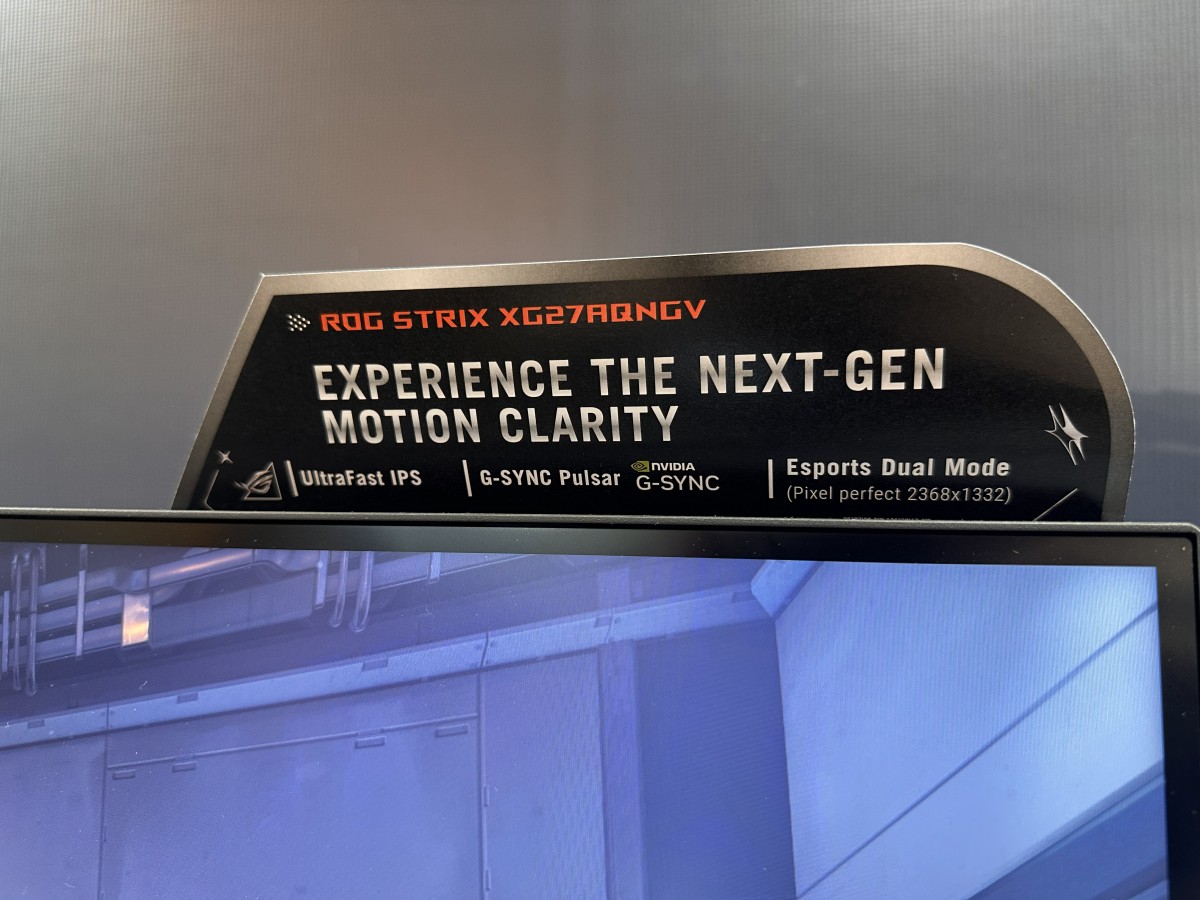
Way back in mid 2024 Asus announced that they were working with NVIDIA to bring G-Sync Pulsar to a new ROG monitor, the result of which we saw here in its final form at CES, ready for launch! The ROG Strix Pulsar XG27AQNGV is built for the esports market and contains all the necessary ingredients for competitive gamers to thrive.
This is a 27″ sized IPS LCD panel, with a 2560 x 1440 resolution and 360Hz refresh rate. According to Asus “the ultrafast IPS technology features the fastest response time we’ve ever achieved in a 1440p LCD display”. It also includes an adjustable aspect ratio setting so you can resize the field of view to 25″ for those who want a smaller screen area to focus on.
- Further reading: NVIDIA G-sync Pulsar Explored – A New Standard for Monitor Motion Blur Reduction
- Further reading: our full review of the ROG Strix Pulsar XG27AQNGV is available here
G-sync Pulsar delivers amazing motion clarity
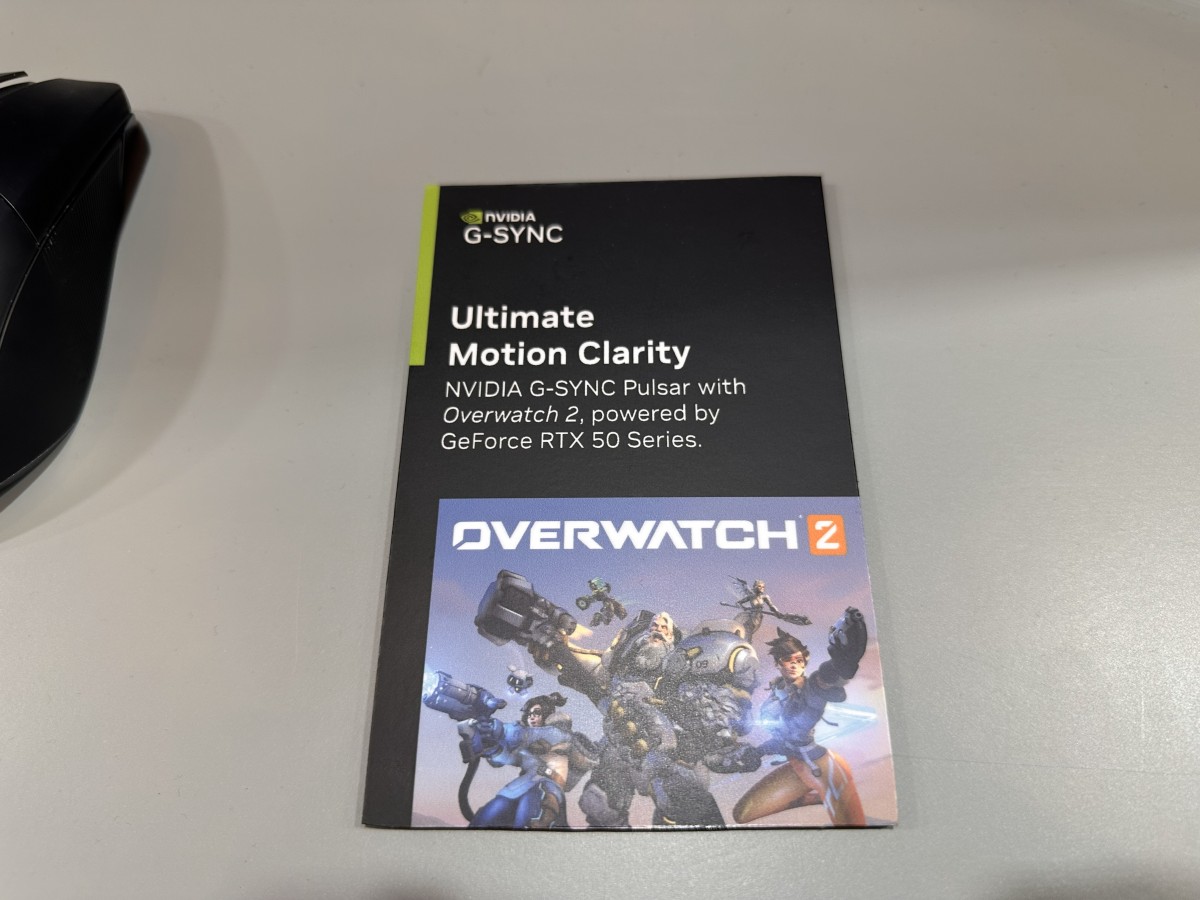
The inclusion of G-sync Pulsar allows you to use a rolling strobe blur reduction backlight mode (like NVIDIA’s ULMB2) at the same time as variable refresh rates, with these monitors being aimed at esports gamers. NVIDIA say that the screens can deliver more than 1000Hz of equivalent perceived motion clarity with VRR. For more information about how G-sync Pulsar works, see our previous post here.
G-sync Ambient Adaptive technology also included
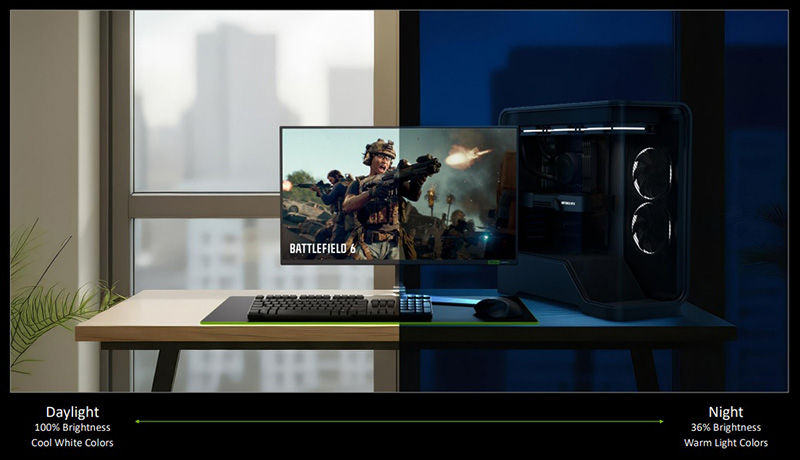
One other related new feature NVIDIA announced which is also worth a mention was ‘G-sync Ambient Adaptive’ technology, which can auto-adjust monitor brightness and colours based on your ambient lighting using a small sensor built in to the top of the screen. That’s a new, previously unannounced feature.
Pricing and availability
G-sync Pulsar monitors are available to buy now in some regions with wider release expected during January. You can check pricing and availability for your region using our affiliate link below. Our full review of the ROG Strix Pulsar XG27AQNGV is also available here
5K meets dual-mode!
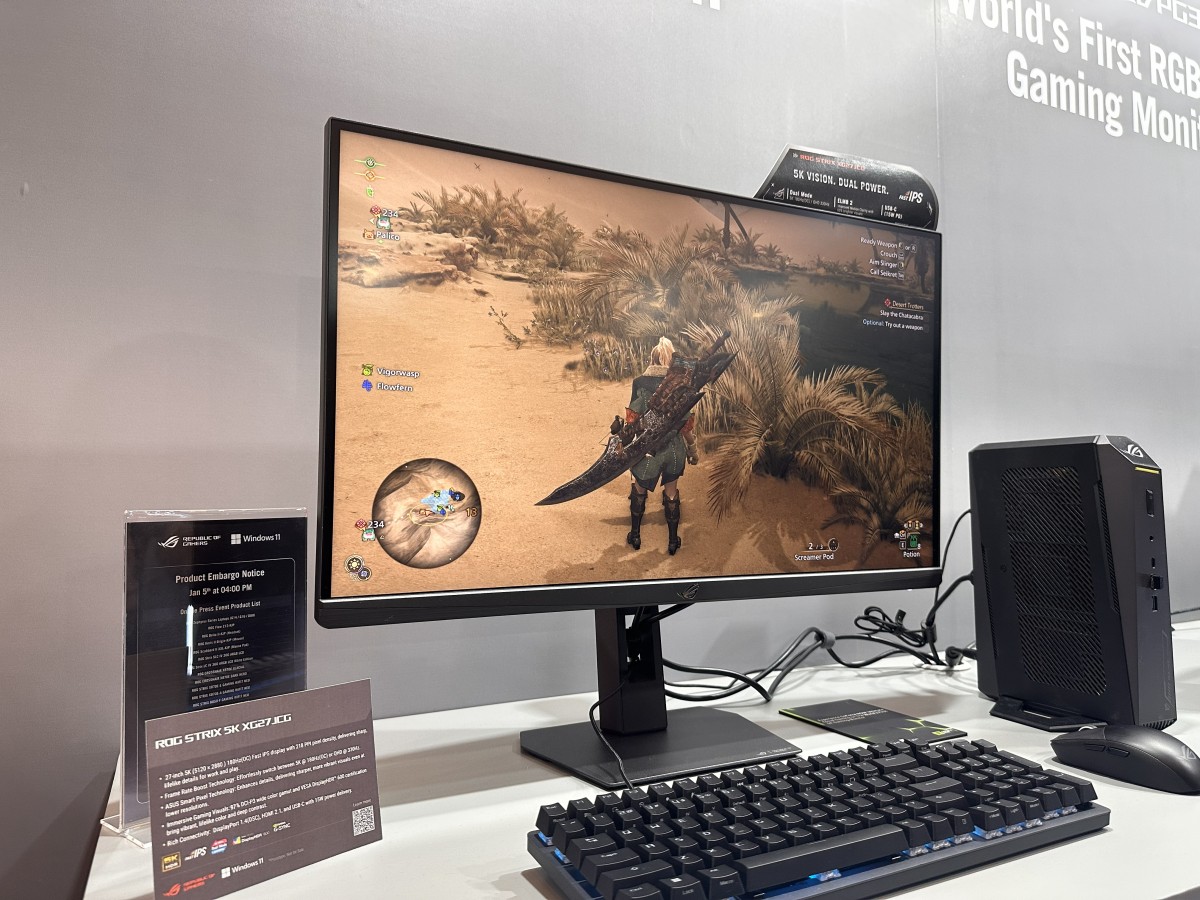
Next up is the ROG Strix 5K XG27JCG which we first brought you news of back in December last year but now we got to see it in person at CES. This is a display that combines ultra-clear visuals with smooth and fluid gameplay to tackle various use cases and gaming situations. You’ve got the choice of prioritising image detail and resolution to very high levels of clarity, or dropping to a lower, but still very good resolution if you want to drive higher speeds and frame rates. The use of a 5K panel allows a decent dual-mode configuration to 1440p, as opposed to the typical 4K / 1080p offerings you will find on the market.
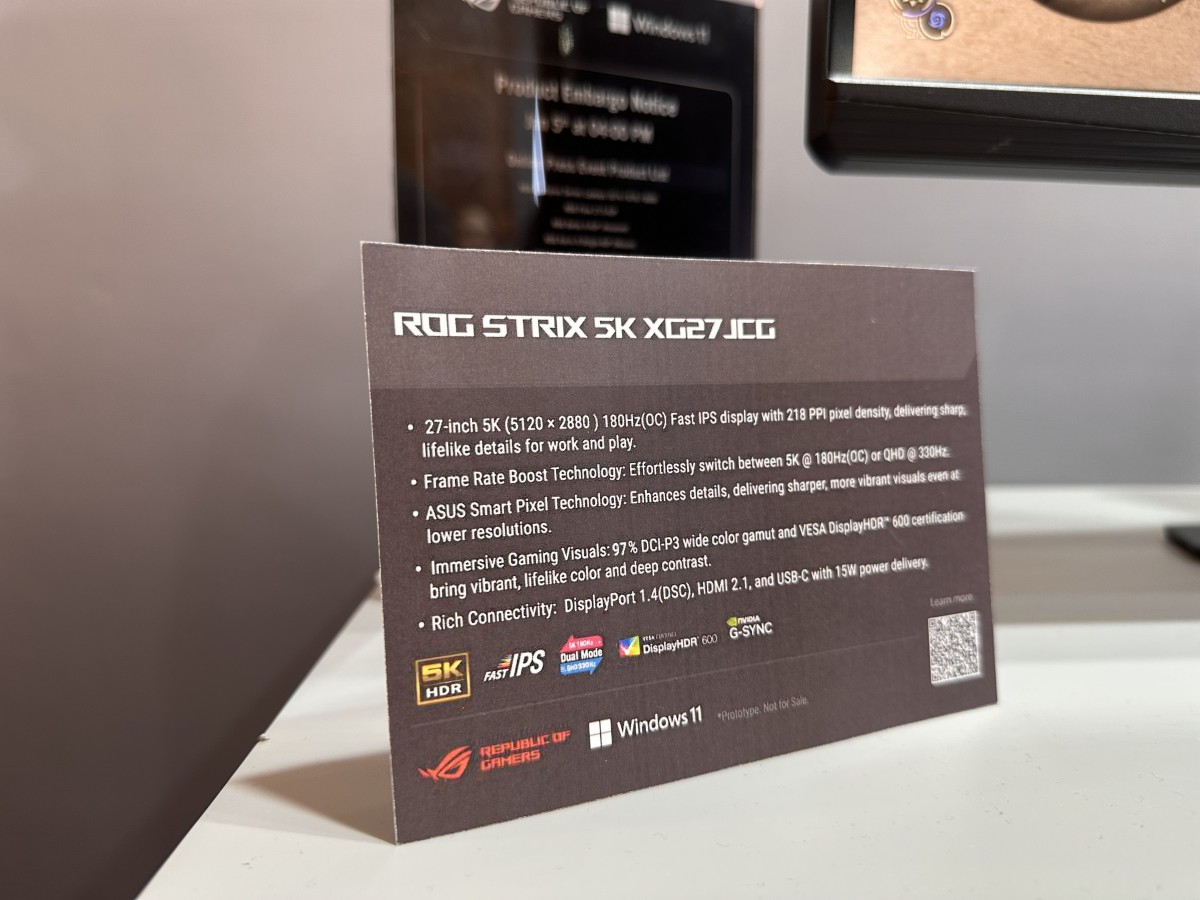
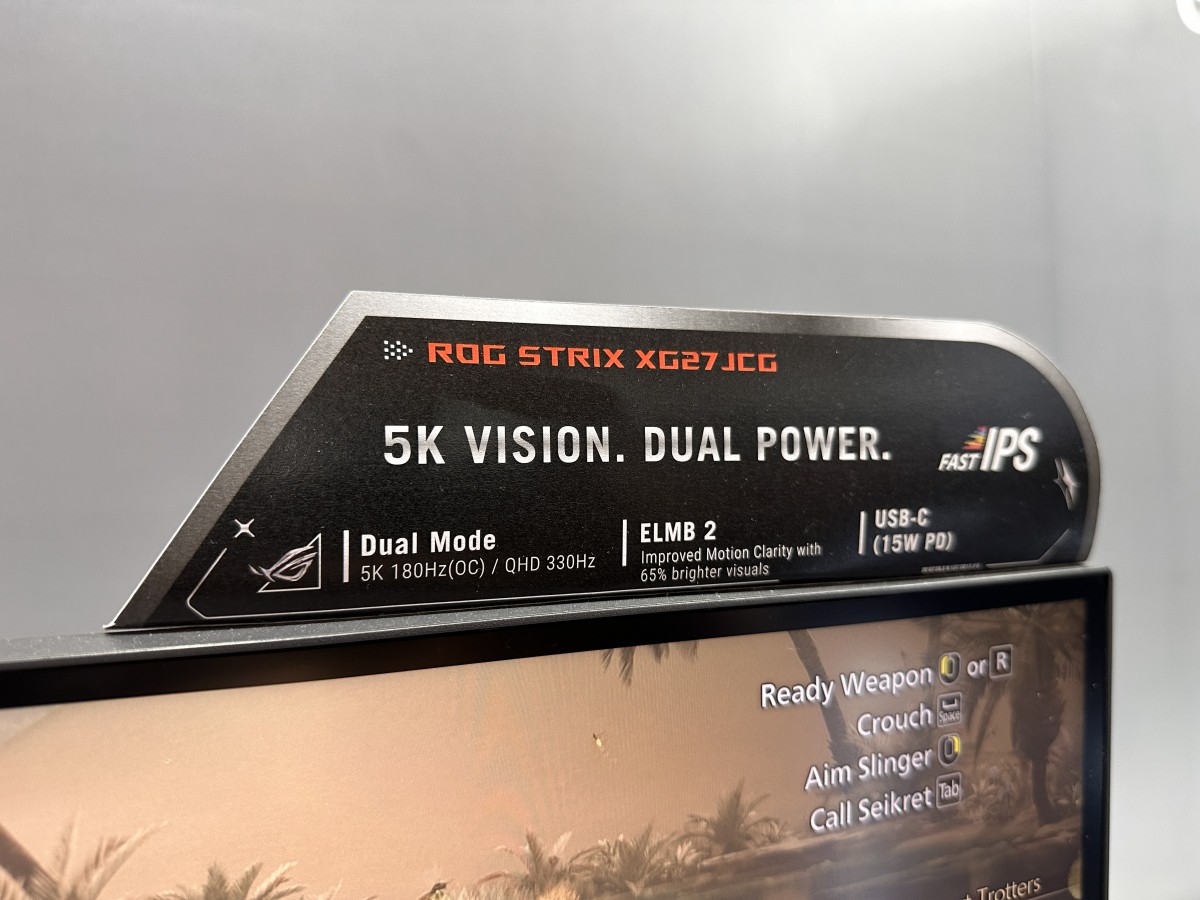
It is a 27″ sized screen built around a ‘Fast IPS’ panel, boasting a 5120 x 2880 “5K” resolution. Its native 180Hz refresh rate can also be boosted to 330Hz when switching to a 1440p resolution using a dual-mode function, which remains a very good resolution on a screen this size.
Other specs include 218 PPI pixel density for super clear and sharp images (which Apple would classify as “Retina”), 0.3ms G2G response time spec, 1000:1 contrast ratio, 350 nits brightness (SDR), 178/178 viewing angles, 10-bit colour depth and a wide colour gamut covering 97% of the DCI-P3 colour space. It also offers a factory calibrated Delta E<2 accuracy.
For HDR there is certification under the VESA DisplayHDR 600 tier and a peak brightness of 600 nits, so there’s some modest edge-lit local dimming on offer from the backlight.
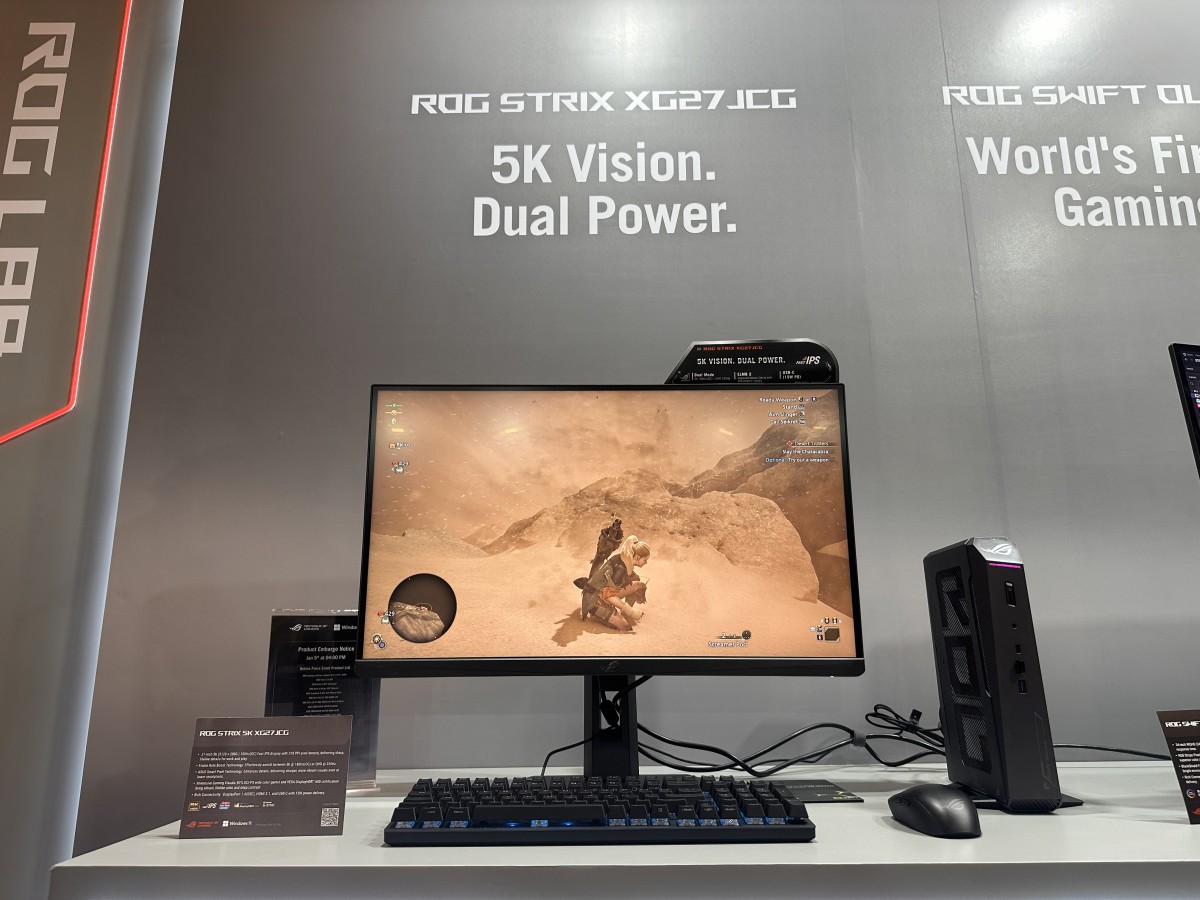
The native 180Hz refresh is supported by adaptive-sync for VRR from compatible systems, including NVIDIA and AMD systems. It also features Asus’s Extreme Low Motion Blur 2 (ELMB 2) technology with a dual-backlight design which helps balance blur reduction with brightness to minimise motion blur and ghosting. Other gaming highlights are the inclusion of the Asus ROG Gaming AI technology, namely Dynamic Shadow Boost, Dynamic Crosshair and AI Visual to aid gameplay.
Asus’ DisplayWidget Center software is included which allows you you to customise your gaming set-up, whilst the Asus Aura Sync feature allows you to synchronize the RGB backlighting across multiple compatible devices. Connectivity comprises 1x HDMI 2.1 ports, 1x DisplayPort 1.4 and a headphone jack. In addition, there is 1x USB 3.2 Type-C (with DP Alt Mode and 15W power delivery), 1x USB 3.2 Type-B and 3x USB 3.2 Type-A ports.
Asus CES 2026 Event Video Coverage
We may earn a commission if you purchase from our affiliate links in this article- TFTCentral is a participant in the Amazon Services LLC Associates Programme, an affiliate advertising programme designed to provide a means for sites to earn advertising fees by advertising and linking to Amazon.com, Amazon.co.uk, Amazon.de, Amazon.ca and other Amazon stores worldwide. We also participate in a similar scheme for Overclockers.co.uk, Newegg, Bestbuy , B&H and some manufacturers.